V-Shaped Reversal Pattern
The V-Shaped Reversal Pattern is a high-probability reversal setup that occurs when price makes a sharp rejection from a key volatility level, creating a distinctive visual pattern on price charts. This pattern is characterized by a rapid shift in market sentiment that creates a distinct “V” shape, representing an abrupt change from one directional move to the opposite direction without significant consolidation. By identifying these setups with proper confirmation, traders can capitalize on powerful momentum reversals with clearly defined entry and exit points that offer excellent risk-reward ratios. The pattern is one of the most reliable reversal signals when it occurs at statistically significant volatility levels with proper confirmation from volume and momentum indicators. The decisiveness of the price action in V-shaped reversals demonstrates clear shifts in supply and demand that create powerful trading opportunities.
What is a V-Shaped Reversal?
A V-Shaped Reversal occurs when price reaches an extreme level, typically at the edge of the Volatility Box, and then immediately reverses direction with strong momentum rather than consolidating or retesting the level. Unlike gradual trend changes that develop over time with multiple retests and consolidation periods, this pattern shows decisive rejection that indicates one side of the market has been completely overwhelmed. The key characteristic of this pattern is the sharp, immediate reversal without significant consolidation or retesting of the extreme level, which demonstrates that buyers or sellers have been decisively defeated. This indicates that buyers or sellers have been completely overwhelmed at that price level, creating a high-probability opportunity for a reversal trade with defined risk parameters. The pattern’s reliability stems from the clear evidence of supply and demand imbalance that it reveals through price action. When one side of the market capitulates at an extreme level, it often creates explosive movement in the opposite direction as positions are forced to unwind.
Key Characteristics
V-Shaped Reversals exhibit sharp price movement where price reaches an extreme level and immediately reverses with strong momentum in the opposite direction, creating the distinctive V shape. The pattern shows clear rejection without consolidation or retesting of the extreme level before the reversal begins, demonstrating decisive market action. These reversals are often accompanied by increased volume that confirms the strength of the reversal and validates that institutional participation is driving the move. The Volatility Box alignment is critical, as the reversal typically occurs at key Volatility Box levels, particularly the Cyan Entry Line, which represents statistically significant price extremes. These characteristics work together to create a highly recognizable pattern that experienced traders can identify quickly and act upon with confidence. The combination of visual clarity, volume confirmation, and statistical significance makes V-shaped reversals among the most reliable reversal patterns available.
Identifying V-Shaped Reversals
Visual Recognition
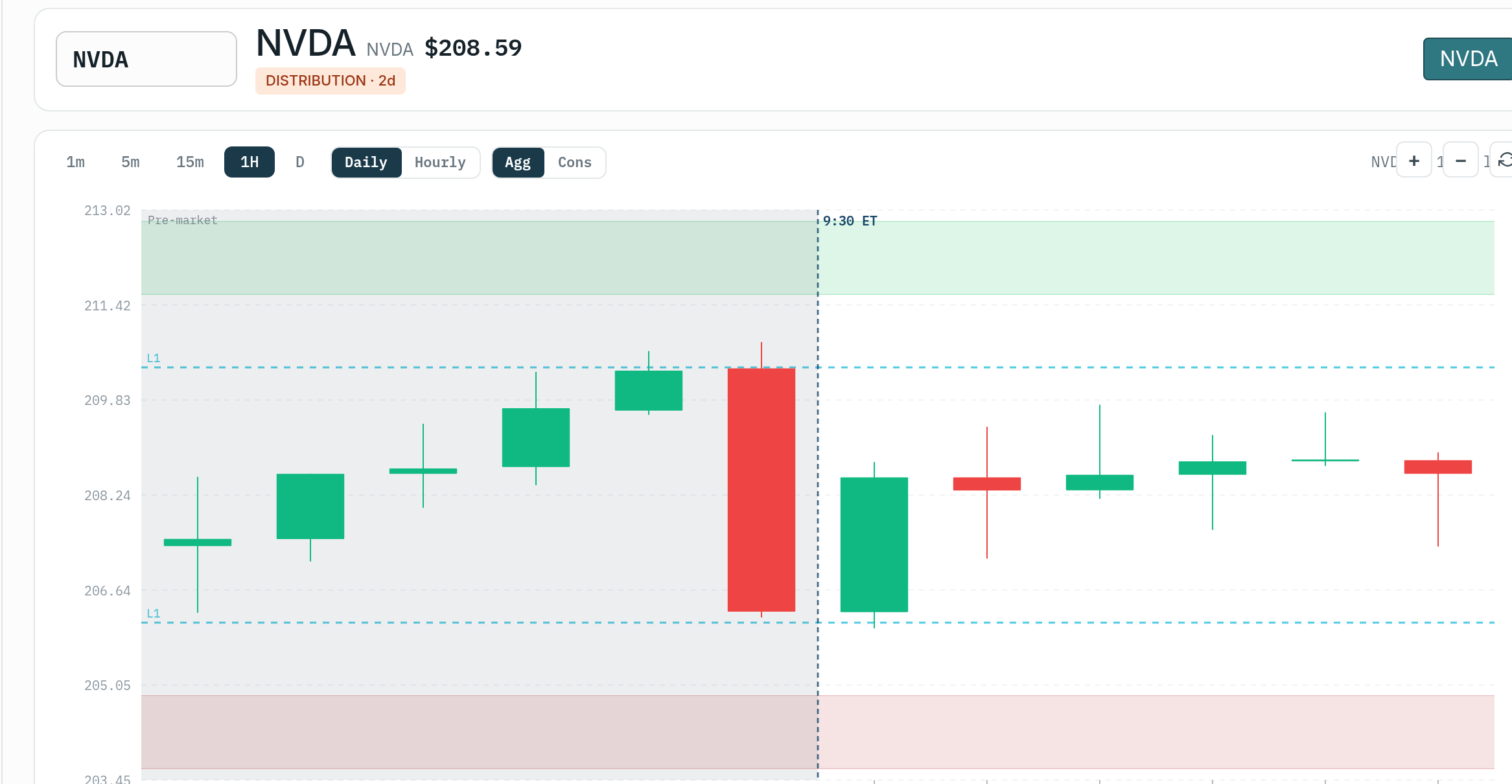
On a chart, a V-Shaped Reversal appears as a sharp move to an extreme price level forming the left side of the V, followed by an immediate and equally sharp reversal in the opposite direction forming the right side of the V. The turning point shows minimal consolidation or sideways movement, distinguishing it from other reversal patterns that develop more gradually. This visual clarity makes the pattern easy to recognize once traders understand what to look for, though confirmation is still required before trading. The lack of consolidation at the turning point is what gives the pattern its distinctive V shape and signals the decisive nature of the reversal. Traders who learn to spot these patterns quickly can position themselves advantageously before the full reversal develops.
Confirmation Signals
To validate a V-Shaped Reversal setup and ensure it’s genuine rather than a false signal, the Edge Signal Indicator should trigger at the extreme level, confirming that price has reached statistically significant overbought or oversold conditions. Volume spikes at the reversal point confirm strong momentum and institutional participation, indicating that the reversal has the power to sustain itself rather than quickly reversing again. The Momentum Cross indicator should confirm the directional shift, providing additional evidence that momentum has genuinely changed rather than just paused temporarily. Finally, price should reach or exceed the Cyan Entry Line before reversing, ensuring the move qualifies as statistically extreme and worthy of a counter-trend trade. These multiple confirmations working together create high-probability setups that are significantly more reliable than trading the visual pattern alone. By requiring all confirmations to align, traders filter out the many false reversals that appear visually similar but lack the underlying strength to follow through.
Trading V-Shaped Reversals: Step-by-Step
Step 1: Wait for Price to Reach Extreme Levels
Monitor for price approaching the Cyan Entry Line on the Volatility Box, as this is where V-Shaped Reversals are most likely to occur due to the statistical significance of these levels. Patience is essential during this phase, as premature entry before price reaches the extreme level significantly reduces the probability of success. The extreme level represents the zone where the statistical edge for reversal trading is highest based on historical volatility patterns. By waiting for price to fully extend into these extreme zones, traders position themselves where mean reversion forces are strongest and reversal probability is maximized.
Step 2: Confirm the Reversal
Once price reaches the extreme level, wait for the Edge Signal confirmation that validates the reversal conditions are genuinely present rather than anticipated. Look for sharp price rejection visible as a strong reversal candle that demonstrates decisive market action in the opposite direction. Confirm that volume increases at the turning point, which validates that the reversal has institutional participation and isn’t just retail traders being shaken out. All three confirmations should align simultaneously for the highest-probability setups that justify full position sizing according to your risk management rules. When all confirmations align, the setup transforms from a hopeful pattern into a statistically validated trade with clear edge.
Step 3: Enter the Trade
Enter the trade as soon as the reversal is confirmed through all required indicators, ideally on the first strong reversal candle with Edge Signal confirmation to capture optimal pricing. Execute the entry promptly to avoid missing the initial momentum thrust that often provides the best risk-reward opportunity. Delaying entry in hopes of better pricing often results in missing the trade entirely or entering at less favorable levels after the initial move has already occurred. V-shaped reversals can move quickly once they begin, so prompt execution after confirmation is essential to capturing the best risk-reward on the trade.
Step 4: Set Stop Loss
Place stops just beyond the extreme point of the V pattern to protect against the scenario where the reversal fails and the original move continues. For bullish reversals, position stops below the low of the V-shaped bottom where the pattern would be invalidated by further downside movement. For bearish reversals, place stops above the high of the V-shaped top where additional upside would negate the reversal hypothesis. Alternatively, use the outer edge of the Volatility Box for wider stops that provide more room for volatility while still maintaining clear invalidation levels for the trade. The stop placement should be wide enough to account for brief price continuation after entry but tight enough to limit losses if the reversal fails completely.
Step 5: Set Profit Targets
The first target should be set at a 1:1 risk/reward ratio to secure initial profits and move the trade toward break-even status as quickly as possible. The second target is the Gray Dashed target line on the opposite side of the Volatility Box, representing the full expected reversal based on statistical volatility models. For extended targets when momentum is particularly strong and confirmed by multiple timeframes, consider the opposite Cyan Entry Line as the maximum profit potential. This tiered approach to profit targets allows you to secure gains progressively while maintaining exposure to the full profit potential of strong reversals. By taking partial profits at the first target and letting the remainder run to the second target with a break-even stop, traders create an optimal balance between securing gains and maximizing profit potential.
Step 6: Manage the Trade
Once the first target is hit, move stops to break even immediately to eliminate all risk from the position while maintaining exposure to further profit potential. Consider taking partial profits by closing 50% of the position, which locks in gains while allowing the remaining portion to run to the second target. Let the remaining position run to the second target with the break-even stop protecting against giving back any profits, creating a risk-free scenario for additional gains. This disciplined management approach ensures that winning trades contribute positively to your account even if the second target is never reached. By protecting gains aggressively and managing the trade in stages, traders ensure that V-shaped reversals always add to their account growth even when the full profit potential isn’t realized.
Enhancing V-Shaped Reversal Trades
Multi-Timeframe Analysis
V-Shaped Reversals are more reliable when aligned across multiple timeframes, providing confirmation that the reversal isn’t contradicted by stronger trends on higher time horizons. Check the higher timeframe to ensure you’re not trading against a major trend that could overwhelm your reversal position shortly after entry. Use the lower timeframe for precise entry timing that allows you to enter at the optimal point within the reversal pattern with tighter stops and better risk-reward. This multi-timeframe approach combines the conviction of higher timeframe confirmation with the precision of lower timeframe execution for maximum effectiveness. By ensuring alignment across timeframes, traders dramatically improve the probability that the reversal will develop fully and reach profit targets.
Market Pulse Alignment
V-Shaped Reversals have higher probability when the Market Pulse is neutral, showing yellow or orange coloring that indicates potential trend change rather than strong directional bias. Trading in the direction of emerging Market Pulse color change adds additional confirmation that broader market sentiment is shifting to support your reversal trade. When the Market Pulse strongly contradicts your reversal direction, consider reducing position size or avoiding the trade entirely as the probability decreases significantly. The Market Pulse provides valuable context about whether the broader market environment supports reversal attempts or is likely to overwhelm them with continued momentum in the original direction.
Time of Day Considerations
V-Shaped Reversals are most reliable during the opening hour from 9:30 to 10:30 AM ET when high volume supports sharp reversals and provides the liquidity needed for decisive price movement. The power hour from 3:00 to 4:00 PM ET also produces reliable V-Shaped Reversals as end-of-day positioning creates sharp moves from institutional traders adjusting positions. Avoid trading these patterns during midday periods from 11:00 AM to 2:00 PM when volume is lower and price action tends to be choppier and less decisive, increasing the likelihood of failed reversals. Volume and liquidity are critical for V-shaped reversals to develop properly, making time of day an important consideration when evaluating potential setups.
Common Mistakes to Avoid
Mistake 1: Entering Too Early
Entering before all confirmations are present can result in trading a continuation instead of reversal, often leading to immediate losses as price continues in the original direction. The temptation to anticipate the pattern and secure better pricing causes traders to enter before the reversal has genuinely begun. The solution is to wait for Edge Signal and volume confirmation before entering, exercising patience even when the pattern appears likely to develop. This discipline ensures you only trade genuine V-Shaped Reversals that have passed all validation criteria rather than anticipated patterns that never materialize. The price you pay for waiting for confirmation is always less than the cost of premature entries that result in losses.
Mistake 2: Using Tight Stops
Stops placed too close to entry can get hit by normal price fluctuation that occurs even during valid reversal setups, turning potential winners into unnecessary losses. The desire to minimize risk leads traders to use stops that don’t account for the volatility inherent in the market being traded. The solution is to place stops beyond the extreme point of the V pattern, giving the trade room to work while still maintaining clear invalidation levels. This approach balances protection with realistic expectations about price behavior during reversals. V-shaped reversals often experience brief price continuation after entry before the full reversal develops, and stops must accommodate this behavior.
Mistake 3: Holding Too Long
V-Shaped Reversals can retrace quickly after the initial move, and holding the entire position without taking partial profits risks giving back gains that were already achieved. The psychology of greed causes traders to want maximum profit from every trade rather than accepting solid but not perfect results. The solution is to take partial profits at the first target and secure the remaining position with a break-even stop, which protects gains while maintaining upside exposure. This management discipline ensures that V-Shaped Reversals contribute positively to your account even when they don’t reach their full profit potential. By managing the trade in stages, traders ensure that successful setups always add to account growth.
Mistake 4: Ignoring Volume
Low volume reversals are less reliable and more likely to fail because they lack the institutional participation needed to sustain directional movement beyond the initial reversal. Trading patterns without volume confirmation significantly reduces the probability of success and increases the risk of false signals. The solution is to only trade V-Shaped Reversals with above-average volume at the turning point, confirming that significant market participants are driving the reversal. This requirement naturally filters out weak patterns that appear visually similar but lack the underlying strength to follow through. Volume is the fuel that powers reversals, and without it even perfect-looking patterns often fail.
Why V-Shaped Reversals Work
V-Shaped Reversals are effective because they represent decisive shifts in market sentiment where one side has been completely overwhelmed, creating clear supply and demand imbalances that drive price movement. The sharp reversal indicates that buyers or sellers have been exhausted at the extreme level, leading to capitulation that produces powerful moves in the opposite direction. Statistical validation comes from the fact that these reversals occur at mathematically significant volatility levels derived from historical price behavior and standard deviation calculations. Momentum confirmation through multiple indicators aligning simultaneously provides additional evidence that the reversal is genuine rather than a brief pause before continuation. The patterns offer risk-reward clarity through well-defined entry and stop levels that create favorable risk-reward ratios, often exceeding 2:1 or 3:1 when all confirmations align properly. By combining Volatility Box levels with volume and momentum confirmation, V-Shaped Reversals provide high-probability trading opportunities with clearly defined risk parameters that allow traders to manage positions confidently from entry through exit. The combination of statistical significance, visual clarity, and multiple confirmations creates one of the most reliable reversal patterns available to traders across all markets and timeframes.
Was this article helpful?
Still need help?
Can't find what you're looking for? Our support team is here to help.
Contact Support