Hourly vs Daily Models
Two Timeframes, Different Trading Styles
Volatility Box models come in two fundamental varieties: Daily models and Hourly models. Both calculate volatility bands using the same mathematical approach, but they use different timeframes of data which produces dramatically different results. Understanding when to use each model type is essential for matching VB signals to your available trading time and preferred holding periods.
Daily models calculate volatility based on daily price bars, creating one set of bands that remain constant for the entire trading session. These bands are wider and don’t change throughout the day regardless of intraday price action. When price breaches a daily Volatility Box band, it signals a significant move relative to the stock’s recent daily volatility. These are swing trade setups designed for holding periods of 1-5 days.
Hourly models recalculate volatility for every hour of the trading day, creating bands that change hour-by-hour as intraday volatility evolves. These bands are much tighter than daily bands and adjust dynamically throughout the session. When price breaches an hourly VB band, it signals an intraday extreme relative to that hour’s typical range. These are day trading and scalping setups designed for holding periods of minutes to hours, rarely carried overnight.
How They Appear on the Dashboard

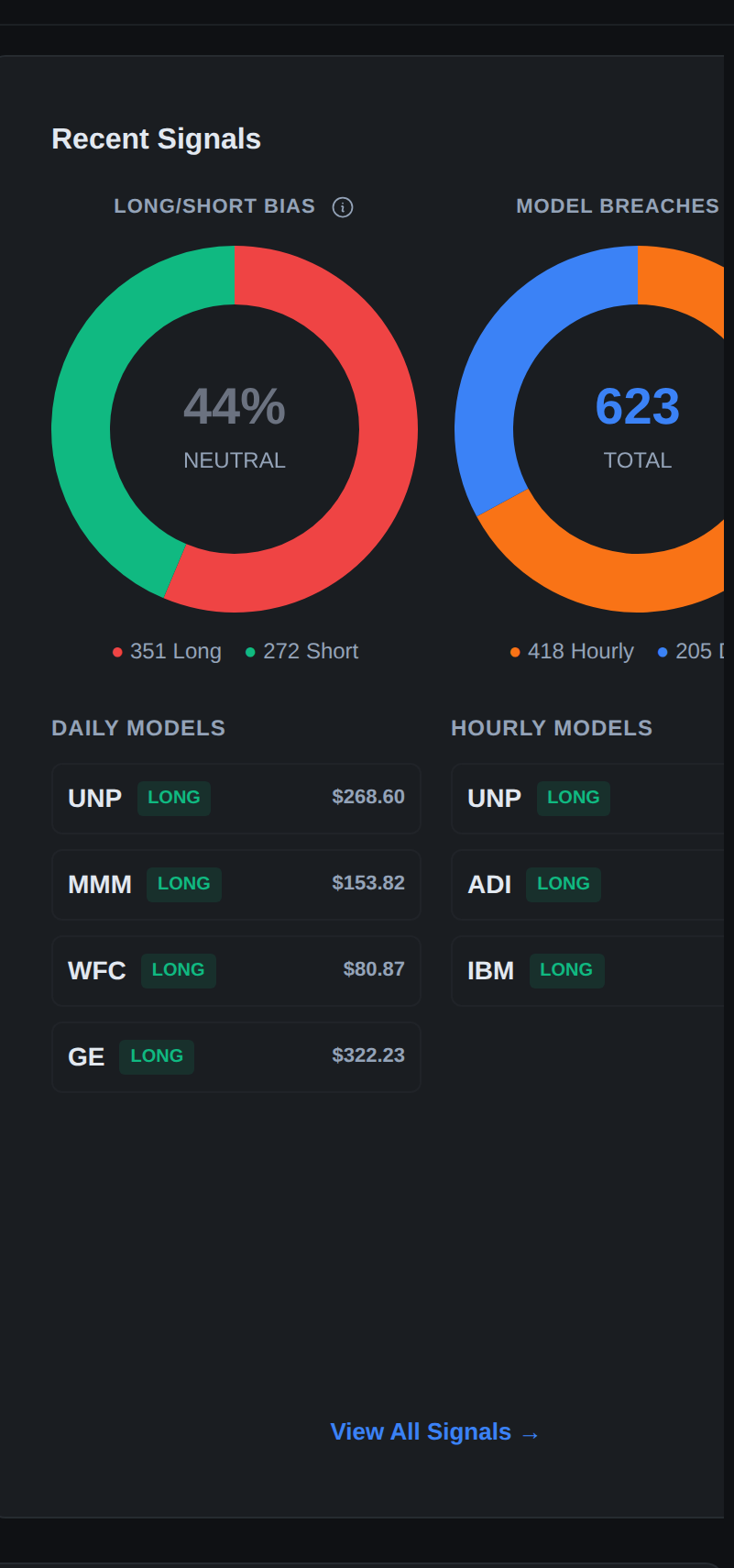
The Dashboard displays total breach distribution between Daily and Hourly models using a pie chart visualization. On most trading days, you’ll see something like 85% Hourly breaches and 15% Daily breaches. This split reflects the fundamental difference in band tightness. Hourly bands are narrower so they get breached more frequently throughout the day, while daily bands are wider so they require more significant moves to trigger.
When you see Daily breaches climbing to 25-30% of total breaches instead of the typical 15%, that’s a signal that today is seeing unusually large moves relative to recent daily ranges. Stocks are stretching beyond their normal daily volatility, which often indicates strong trending conditions or elevated macro volatility. These are the days when swing traders should pay extra attention because daily band breaches are delivering higher-quality multi-day setups.
Conversely, if Daily breaches drop below 10% while Hourly breaches dominate at 90%+, the market is experiencing normal intraday chop without significant daily-timeframe moves. This is a stock-picker’s market where day traders thrive but swing traders struggle to find clear trending opportunities. Adjust your strategy based on this distribution. On low daily-breach days, focus on scalping and day trades rather than hunting for swing positions.
Daily Models: One Level for the Entire Day

When you load a Daily VB model on your ThinkorSwim chart or view it on the VB Symbol Page, you see two horizontal lines that don’t move throughout the trading session: one upper band for potential short entries and one lower band for potential long entries. These levels are calculated Sunday evening before market open using the past 30 days of daily price data, and they remain fixed for the entire week.
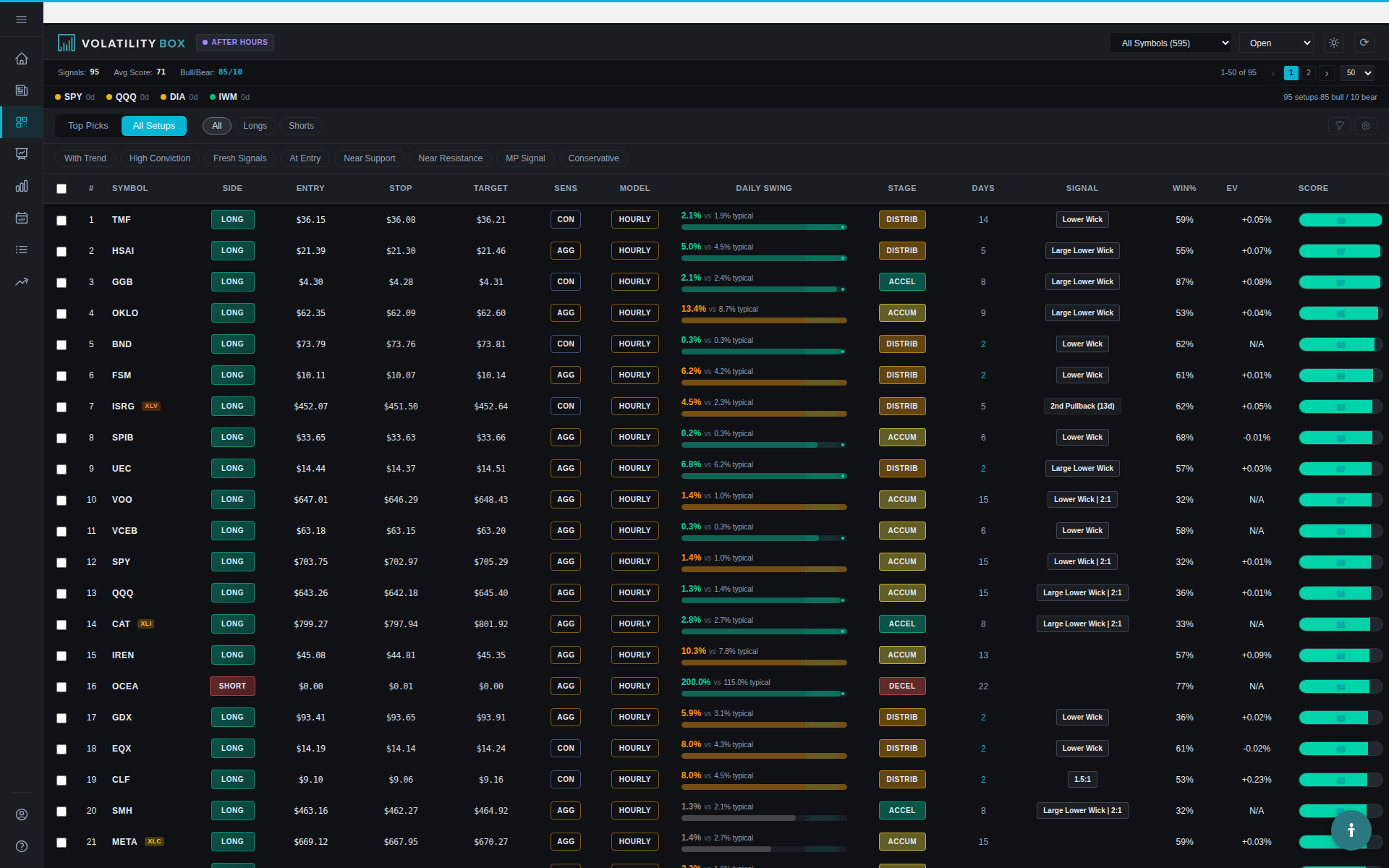
Daily models come in two versions: Aggressive and Conservative. Daily Aggressive uses tighter bands that trigger 8-15 signals per day across the entire symbol universe. Daily Conservative uses wider bands that generate only 2-6 signals per day. These are the highest-quality, rarest setups in the entire Volatility Box system. As a general rule, the wider the band the higher the win rate but the lower the signal frequency. Conservative models sacrifice opportunity count for setup quality.
Because daily bands don’t change intraday, a breach that occurs at 10:00 AM remains a valid signal at 2:00 PM as long as price is still near the band. This consistency makes daily models excellent for swing traders who can’t monitor markets all day. You can check the Scanner once at lunch, see which daily signals have triggered, and make trading decisions without worrying that the setup will be invalid 30 minutes later when you’re able to execute.
Hourly Models: Dynamic Intraday Levels

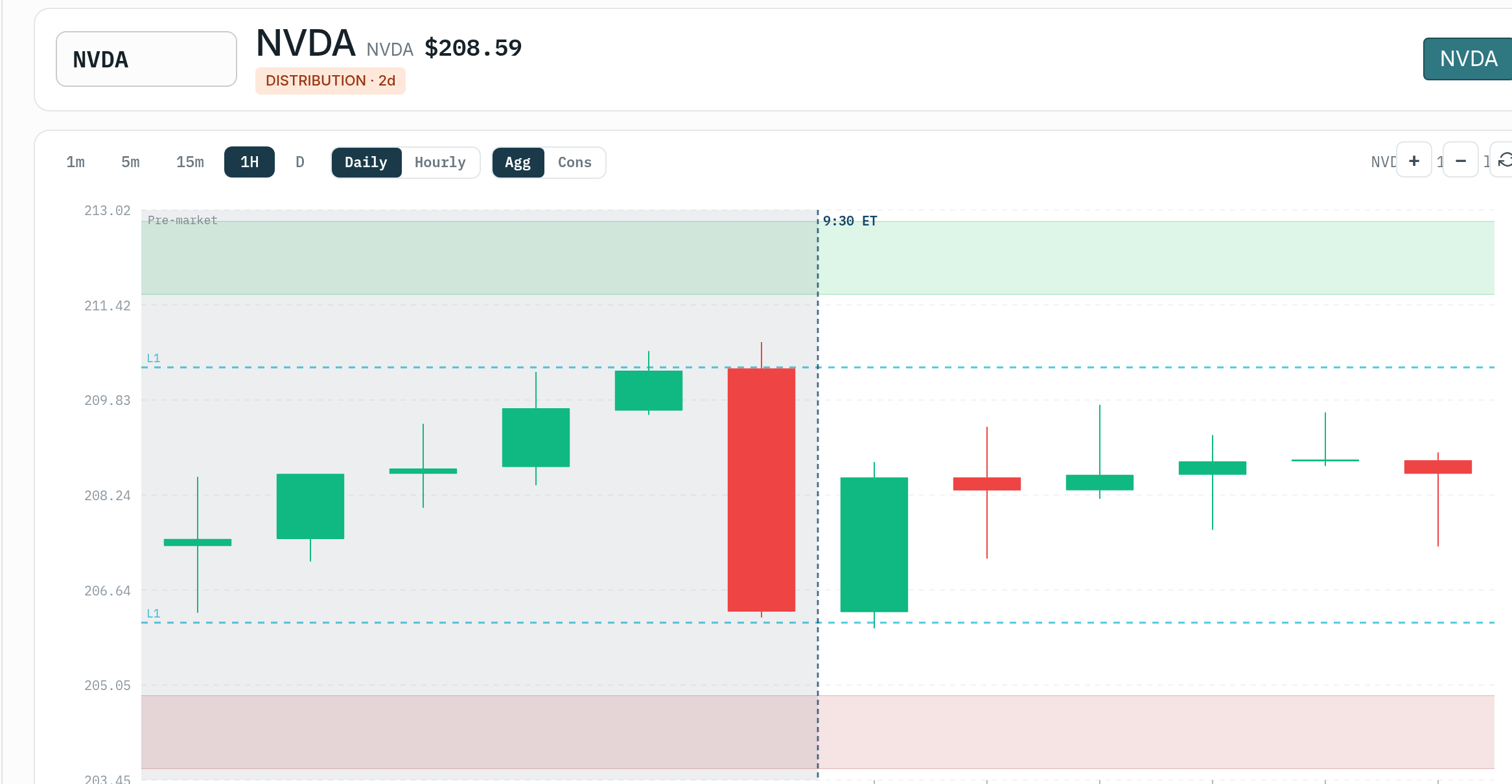
Hourly Volatility Box models display on your chart as bands that shift hour-by-hour, creating a stair-step pattern throughout the trading day. At 9:30 AM one set of bands is active. At 10:30 AM those bands shift to new levels based on the 10:00-11:00 hour’s expected volatility. At 11:30 AM they shift again, and so on through the close. This dynamic adjustment means hourly models are constantly adapting to real-time market conditions.
Like daily models, hourly models come in Aggressive and Conservative versions. Hourly Aggressive generates 15-40 signals per day with breaches occurring every 15-30 minutes during active periods. These are pure scalping setups for traders who want constant action. Hourly Conservative produces only 2-8 signals per day with much wider intraday bands. These work well for day traders who want to hold positions for 2-6 hours but close everything by end of day.
The key difference from daily models is that hourly signals can become obsolete quickly. A breach of the 10:00 AM hourly band loses relevance once the 11:00 AM bands activate, because the volatility calculation has reset for the new hour. This makes hourly models less suitable for swing trading but perfect for active intraday traders who can act on signals within minutes of their appearance.
Breach Frequency and Win Rate Tradeoffs
Here’s the fundamental tradeoff: Hourly Aggressive triggers the most frequently with 15-40 signals per day but has the lowest win rate at 52-58%. Hourly Conservative triggers less often at 2-8 signals per day but improves win rate to 48-54%. Daily Aggressive finds middle ground with 8-15 signals daily and 54-60% win rate. Daily Conservative produces the fewest signals at 2-6 per day but delivers the highest win rate at 56-64%.
These statistics reveal a clear pattern: the tighter the bands the more signals you get but the lower the quality of each individual signal. Conversely, the wider the bands the fewer signals appear but each one carries higher probability. This is why experienced VB traders often use Hourly Aggressive for morning scalping when they want maximum opportunities, then switch to Daily Conservative for afternoon swing positions when they’re looking for their best 1-2 setups to hold overnight.

The Dashboard helps you make this decision in real-time. If total breaches are running at 1,200+ (high volatility day), Hourly Aggressive will be firing constantly and you can profitably scalp those opportunities. If total breaches sit at 600 (average day), you’ll want to be more selective and focus on Daily models to avoid getting chopped up by marginal hourly signals. Let the Dashboard’s total breach count guide your model selection.
Daily Models for Swing Trading
If you trade a full-time job and can only check markets during lunch and after close, daily models are your only realistic option. The signals remain valid for hours, you’re not trying to scalp 5-minute moves, and the multi-day holding period means you don’t need to monitor positions constantly. Daily Conservative specifically targets swing traders with 3-5 day hold times and produces just 2-6 high-quality setups daily. This is perfect for someone with limited time who wants only the best opportunities.
Even full-time day traders often keep a Daily Conservative Scanner tab open in a separate browser window. While they’re actively scalping Hourly Aggressive signals in their primary Scanner tab, that Daily Conservative tab runs quietly in the background. When a rare Daily Conservative signal triggers with 85+ conviction, it interrupts the day trading flow because these setups are too good to ignore. Take the swing trade, set the stop, define the target, then return to day trading while letting the swing position work over the next few days.
The mistake many new Volatility Box traders make is trying to day trade Daily model signals. They see a Daily Aggressive breach at 10:00 AM, enter the trade, watch it chop sideways for 2 hours, get bored, and exit at breakeven. Then over the next 2 days the trade hits its full target, but they’re no longer in it because they mismatched holding timeframe to model timeframe. Daily models require patience and a willingness to hold through normal intraday noise. If you can’t do that, stick with hourly models instead.
Hourly Models for Day Trading and Scalping
Active day traders who monitor markets from 9:30 AM to 4:00 PM thrive on hourly models. Hourly Aggressive specifically serves scalpers looking to enter and exit trades within 30 minutes to 2 hours maximum. These tight bands trigger constantly during volatile market hours, providing a steady stream of opportunities for traders who can act quickly on signals as they appear in real-time.

The Volatility Timeline on the Dashboard becomes especially valuable for hourly model trading. If the timeline shows that 9:30-10:30 AM consistently produces 140+ breaches while 11:00 AM-1:00 PM only generates 60 breaches, you know to focus your active trading energy on the morning session and scale back during midday. This data-driven approach to trading hours prevents you from forcing trades during low-volatility windows when even hourly models struggle to produce clean setups.
Hourly Conservative offers a middle ground for day traders who want better risk-reward ratios than Hourly Aggressive provides but don’t want to hold overnight like Daily models require. These wider intraday bands produce 2-8 signals daily that typically target 2-6 hour holds. This is perfect for taking a position at 10:00 AM and closing it at 2:00 PM before the market close. This timeframe matches many day traders’ comfort level of being in trades long enough to capture meaningful moves but always flat by the closing bell.
Combining Both Model Types
Sophisticated VB traders don’t choose between hourly and daily models. They use both simultaneously for different purposes. The common multi-tab Scanner approach involves Tab 1 running Hourly Aggressive for active scalping with 5-10 minute chart timeframes, Tab 2 displaying Daily Aggressive for day trades with 15-30 minute chart timeframes, and Tab 3 showing Daily Conservative for swing trades with daily chart timeframes. Throughout the day, you cycle between tabs based on what you’re hunting for at that moment.
This layered strategy ensures you’re matching model to opportunity type. When you spot a high-conviction Daily Conservative signal on Tab 3, you take it as a swing trade and set it aside. Meanwhile, Tab 1 continues generating Hourly Aggressive scalps that you trade actively for quick profits. The daily swing trade works in the background over multiple days while your intraday activity continues unaffected. This separation of timeframes prevents the common error of managing a swing trade with a scalper’s mindset.
Another powerful combination is using Daily models to identify directional bias, then executing with Hourly models. If the Dashboard shows a symbol breached its Daily Conservative lower band (strong buy signal), you switch to that symbol’s Hourly Aggressive chart and wait for hourly band breaches in the same direction. You’re using the daily breach to confirm multi-day trend exhaustion, then using tighter hourly entries to improve your entry price within that larger daily setup. This multi-timeframe confirmation dramatically improves win rates because you’re not fighting against the daily-level trend.
Model Selection by Available Trading Time
If you can monitor markets all day from 9:30 AM to 4:00 PM, use all models and expect 15-30 total trades per week across scalps, day trades, and swings. When only morning hours from 9:30-11:00 are available, focus exclusively on Hourly Aggressive for 8-15 trades weekly concentrated in that window. Power hour traders from 3:00-4:00 PM should use Hourly Aggressive or Daily Aggressive for 5-10 weekly trades in that final volatile hour.
If you can only check markets 2-3 times per day for 15 minutes each session, Daily Conservative is your only realistic option. Expect 2-5 swing trades weekly that you enter during your market check-ins and manage with preset stops and targets. End-of-day only traders who check markets after 4:00 PM close should also use Daily Conservative exclusively, taking 2-4 swing trades weekly based on signals that triggered during the day and planning entries for the next morning or using after-hours markets if available.
The worst mistake is using Hourly models when you can’t actively monitor markets. You’ll miss the optimal entry because the hourly band shifted 30 minutes after the signal triggered, or you’ll enter late and get stopped out as the setup deteriorates. Match your model to your available screen time. If you’re not watching markets in real-time, you have no business trading hourly models. Use daily models instead and save yourself the frustration of missed opportunities and poorly-timed entries.
Stop Distances and Position Sizing Implications
Daily models generate wider stops than hourly models because they’re designed to withstand normal daily volatility. A Daily Conservative signal might have a $4-10 stop distance per share to accommodate overnight gaps and multi-day price swings. This wide stop requires smaller position sizing. If you normally risk $400 per trade and the stop is $8.00 per share, you can only buy 50 shares. Contrast this with Hourly Aggressive where the stop might be only $1-2 per share, allowing you to buy 200-400 shares with the same $400 risk.
This position sizing difference means hourly models produce smaller dollar gains per trade even when they hit full targets, but they make up for it through frequency. You might make $150 on a typical Hourly Aggressive trade with 200 shares moving $0.75 in your favor. Meanwhile, a Daily Conservative trade with 50 shares might gain $6.00 per share for $300 profit. That’s double the gain but you get one-third as many opportunities. Over a month, the total P&L can be similar despite completely different trade counts and position sizes.
Understanding this dynamic prevents unrealistic expectations. New traders see a Daily Conservative signal, get excited about the $8 profit target, then enter with their normal 200-share position size thinking they’ll make $1,600. But the $10 stop with 200 shares creates $2,000 risk, which is too much for most accounts. They should have sized down to 50 shares creating $500 risk which is appropriate, but then the profit on a full move is only $400 not $1,600. Match your expectations to the model. Daily models produce larger points-per-trade but require smaller position sizes, hourly models allow larger position sizes but capture smaller point moves.
Next Steps: Testing Both Model Types
For the next two weeks, paper trade five setups using only Hourly Aggressive to experience the fast pace and frequent opportunities. Note the entry timing pressure, the small profit targets, and how quickly signals appear and disappear. Then paper trade five setups using only Daily Conservative to feel the slower rhythm, larger position swings, and patient holding periods required. Track win rate, average profit per trade, and total time spent monitoring each type.
Compare your results across metrics: Which model matched your available screen time better? Which produced more profits per hour of actual trading work? Which win rate was higher? Which holding period matched your psychological comfort? Most importantly, which model type made you feel in control versus stressed and reactive? Your answers to these questions will reveal which model type aligns with your trading personality, available time, and risk tolerance. Then focus exclusively on that model type rather than trying to trade both ineffectively.
Was this article helpful?
Still need help?
Can't find what you're looking for? Our support team is here to help.
Contact Support