Fade Setup
The Fade Setup is a structured approach to trading reversals in volatile markets by capitalizing on price movements that have extended beyond sustainable levels. Unlike traditional mean-reversion strategies that rely on subjective analysis or arbitrary support and resistance levels, this setup is based on statistically validated volatility models that define precise reversal zones. By following predefined rules that remove discretion and emotion from the trading process, traders can take advantage of price extremes while maintaining disciplined risk management. The strategy provides complete guidance on when to enter, where to set stop-loss levels, how to manage profit targets, and when to adjust positions as trades develop. This comprehensive framework transforms counter-trend trading from a risky endeavor into a systematic methodology with clearly defined parameters.
What is the Fade Setup?
The Fade Setup is a counter-trend trading strategy that focuses on capitalizing on price movements that extend beyond normal volatility expectations, creating statistical opportunities for mean reversion. Instead of chasing momentum in the direction of strong moves, traders look for opportunities where price has reached a statistically significant level based on historical volatility and is likely to reverse back toward more sustainable levels. This contrarian approach requires patience and discipline but offers excellent risk-reward opportunities when executed properly with full confirmation. The approach provides clear guidelines on when to enter based on objective criteria, where to set stop-loss levels that balance protection with room for the trade to work, and how to manage profit targets that align with statistical expectations. The strategy is particularly useful for traders looking to eliminate emotional decision-making and execute trades with confidence based on a rules-based system that has been validated through extensive backtesting. By waiting for price to reach extreme levels with proper confirmation, traders can capitalize on market overreactions with clearly defined risk parameters.
Key Components of the Fade Setup
The Fade Setup follows a structured approach to ensure disciplined trade execution that removes subjectivity and maintains consistency across all market conditions. Each component serves a specific purpose in the overall framework and must be present for a valid trade setup. The system naturally filters out low-probability setups by requiring multiple confirmations before any capital is committed. This multi-layered validation process ensures that traders only engage in setups where the statistical edge is clearly present and multiple forms of evidence support the reversal hypothesis.
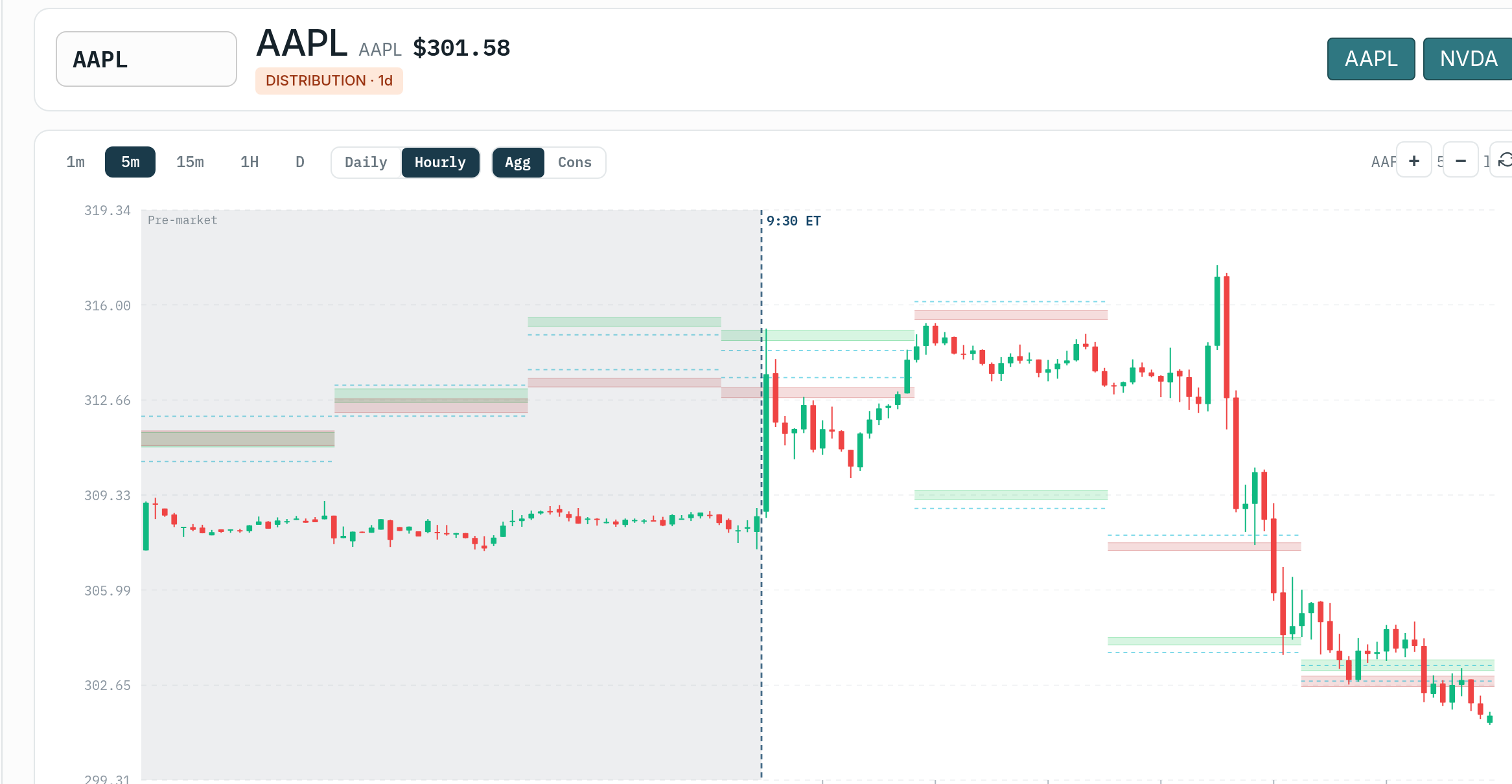
The entry trigger requires that price must breach the Cyan Entry Line, which marks the outer boundary of normal volatility and indicates an extreme move that has statistical reversal potential. Confirmation signals mandate that the Edge Signal Indicator must validate the setup before a trade is initiated, ensuring the reversal is genuinely occurring rather than just hoped for. Stop placement is set at the outer edge of the Volatility Box to manage risk effectively while providing sufficient room for normal price fluctuations without premature stops. Profit targets are defined with the first target at a 1:1 risk/reward ratio to secure initial gains, and the second target at the Gray Dashed target line on the opposite side representing full reversal potential. Risk management requires that once the first target is hit, stops are adjusted to break even or slightly in profit to create a risk-free position for the remainder of the trade. These elements work together seamlessly to create a complete trading methodology that handles every aspect of counter-trend position management.
Executing the Fade Trade: Step-by-Step Guide
Step 1: Identifying a Trade Setup
To ensure a valid trade setup, price must breach the Cyan Entry Line, signaling that it has extended beyond its normal volatility range and created a potential reversion opportunity based on statistical analysis. Additionally, the Edge Signal Indicator must confirm the trade by showing overbought or oversold conditions that validate the extreme price extension. A trade is only executed when both conditions occur simultaneously, which significantly reduces false signals and ensures only high-probability setups are traded. This dual requirement acts as a powerful filter that keeps traders out of marginal situations where only one confirmation is present. The patience required to wait for both confirmations separates successful fade traders from those who consistently get caught in continuing trends.
Step 2: Entering the Trade
Enter the trade inside the Volatility Box cloud zone as soon as the Edge Signal appears, confirming that all required conditions have been met for a valid setup. Determine position sizing based on risk tolerance and overall portfolio strategy, maintaining consistency with your trading plan and never risking more than a predetermined percentage. Proper position sizing is critical to long-term success, as it ensures that even a string of losses won’t significantly impact your trading capital or ability to continue trading. Execute the entry promptly once confirmation appears to capture optimal pricing before the reversal gains momentum and moves away from ideal levels. Delaying entry in hopes of better pricing often results in missing the trade entirely or entering at less favorable levels after the initial reversal move has already begun.
Step 3: Setting Stop Losses
Stops should be placed at the outer edge of the Volatility Box to provide room for price fluctuations while maintaining clear invalidation levels for the trade hypothesis. Aggressive traders who seek tighter risk parameters may opt for closer stops based on additional confirmation indicators from lower timeframes or volume analysis. Conservative traders should use wider stops to avoid premature exits caused by normal market volatility that occurs even during valid reversal setups. The appropriate stop width depends on individual risk tolerance, current market volatility, and the strength of the confirmation signals present at entry. Understanding that reversals don’t happen instantly helps traders set stops that account for initial price continuation before the reversal develops fully.
Step 4: Managing Profit Targets
The first target should be set at a 1:1 risk/reward ratio to ensure profitability and move the trade toward break-even status as quickly as possible, protecting against unexpected reversals. The second target is the Gray Dashed Line on the opposite side of the Volatility Box, representing where price is statistically expected to reach based on historical volatility patterns. Once the first target is hit, traders should adjust stops to break even or lock in partial profits to ensure risk-free trade execution for the remaining position. This disciplined approach to profit management ensures that winning trades contribute positively to overall results even if the full profit potential is never realized. By securing gains progressively and protecting the remainder with break-even stops, traders ensure that successful fades always add to their account growth.
Enhancing the Fade Setup with Additional Confirmations
While the Edge Signal Indicator is the primary confirmation tool for validating reversal setups, integrating additional factors can significantly improve trade accuracy and reduce the occurrence of false signals. These supplementary confirmations add layers of evidence that the reversal is genuine and likely to develop fully. Traders who implement multiple confirmation requirements naturally achieve higher win rates by being more selective about which setups they trade. The goal is to create a robust framework where multiple independent forms of evidence align to support the reversal hypothesis before any capital is committed.
1. Multi-Timeframe Confirmation
Using multiple timeframes to confirm a setup increases reliability by ensuring that the reversal aligns with or doesn’t contradict broader market structure and momentum. A 5-minute confirmation alongside a 1-minute entry signal enhances precision by providing both the bigger picture context and the exact timing for optimal entry. A higher timeframe trend check helps confirm whether the trade aligns with broader market movement or is fighting against dominant momentum that could overwhelm the reversal attempt. This layered approach creates a more robust setup that has validation across multiple time horizons rather than just a single timeframe. By combining the conviction of higher timeframe alignment with the precision of lower timeframe entry, traders achieve both confidence and optimal execution.
2. Market Pulse Indicator for Trend Confirmation
If the Market Pulse is red and signaling bearish conditions, fading a long trade carries higher risk as you’re trading against the prevailing market sentiment and momentum. Conversely, if the Market Pulse is green and indicating bullish conditions, fading a short trade should be avoided or approached with extreme caution. Using the Market Pulse as an additional filter helps ensure that your reversal trades don’t fight against very strong underlying trends that are likely to overwhelm your position. This confirmation can significantly reduce losses from reversal attempts that occur during powerful trending markets. Understanding the broader market context through the Market Pulse helps traders distinguish between reversals that have a realistic chance of success and those that are likely to fail quickly.
3. Recognizing V-Shaped Reversal Patterns
The Fade Setup is highly effective when combined with V-shaped reversals, which indicate strong rejection from the Volatility Box levels with immediate and powerful price movement in the opposite direction. These sharp reversals demonstrate decisive shifts in supply and demand that create high-probability trading opportunities with excellent risk-reward characteristics. Recognizing the visual pattern of a V-shaped reversal adds another layer of confirmation that strengthens the overall setup and increases confidence in the trade. V-shaped reversals show clear evidence that one side of the market has been completely overwhelmed at the extreme level, creating powerful reversal momentum.
Common Mistakes and How to Avoid Them
Even with a structured setup, traders may encounter challenges that lead to unnecessary losses and undermine otherwise sound strategy execution. Below are common mistakes and their solutions that can help traders maintain discipline and consistency. Most errors stem from impatience, lack of discipline, or failure to follow the complete system as it was designed to be implemented. By understanding these pitfalls in advance, traders can develop the awareness necessary to avoid them and maintain proper execution discipline.
Mistake 1: Entering Without Edge Signal Confirmation
Entering too early before the Edge Signal has confirmed the setup increases the risk of trading a continuation instead of a reversal, often resulting in immediate losses. The temptation to anticipate the signal and get better pricing leads traders to enter before any genuine reversal has begun. The solution is to always wait for the Edge Signal before executing a trade, exercising patience even when the setup appears likely to trigger. This single discipline can dramatically improve results by ensuring you only trade setups that have passed all required validation criteria. The trades you miss due to lack of confirmation are often the ones that would have resulted in losses, making patience a profitable virtue.
Mistake 2: Ignoring Multi-Timeframe Confirmation
Trading against the higher timeframe trend without confirming that conditions support a reversal lowers the probability of success as dominant momentum can easily overwhelm counter-trend positions. Reversal trades work best when they align with or at least don’t contradict the broader market structure on higher timeframes. The solution is to use at least one higher timeframe to confirm trade direction, ensuring your reversal attempt isn’t fighting against overwhelming momentum. This additional check can prevent many losing trades that never had a realistic chance of success. By respecting the power of higher timeframe trends, traders avoid the frustration and losses that come from fading trends that aren’t ready to reverse.
Mistake 3: Moving the Stop Loss Too Soon
Tightening stops too early before the trade has had a chance to develop can lead to unnecessary exits that occur just before the reversal begins working. The desire to reduce risk prematurely causes traders to move stops before reaching the first profit target. The solution is to adjust stops only after reaching the first profit target, maintaining the original risk parameters until the trade has proven itself. This discipline allows reversals to develop fully without being cut short by overly aggressive stop management. Reversals often require initial patience as price may continue briefly in the original direction before the genuine reversal develops, and premature stop tightening prevents the trade from working.
Why the Fade Setup Works
The Fade Setup is based on statistical volatility models that have been tested across thousands of trades and market conditions, making it one of the most reliable counter-trend strategies available. Unlike arbitrary support and resistance levels drawn subjectively on charts, these volatility zones are mathematically derived from historical price behavior and standard deviation calculations. The strategy reduces emotional trading by following a structured, rules-based system that removes discretion and subjective judgment from the trading process. It utilizes historical volatility data rather than subjective market interpretations, grounding each trade in statistical probability rather than opinion. The setup filters out low-probability trades using Edge Signal confirmation, ensuring that only genuine reversal setups with multiple validations are executed. It adapts to different market conditions with customizable models that can be adjusted for various symbols and timeframes based on specific volatility characteristics. By only entering trades when price reaches statistically significant volatility levels and the Edge Signal confirms reversal conditions, traders can maintain an edge while effectively managing risk and avoiding the many false signals that plague less disciplined approaches to counter-trend trading. The combination of mathematical precision, multiple confirmations, and systematic risk management creates a powerful framework for trading mean reversion consistently and profitably.
Was this article helpful?
Still need help?
Can't find what you're looking for? Our support team is here to help.
Contact Support