Documentation / Dashboard

Market Pulse Signals

Last updated: January 1, 2025

What Is Market Pulse?

Market Pulse is the VB Platform’s proprietary trend analysis system that evaluates each symbol’s broader trend context and assigns a signal type, trend alignment, and color code to every VB signal. This system operates independently from the VB levels themselves, adding a layer of trend intelligence that dramatically improves trade selection. While VB levels tell you precisely where to enter and exit based on statistical volatility patterns, Market Pulse tells you whether you should actually take the trade based on trend strength, momentum health, and timing within the trend cycle.

Understanding Market Pulse is critical because it represents the difference between trading with a 55% win rate when using no trend filter and achieving a 65% win rate when filtering for WITH-trend Green Market Pulse setups. This 10-percentage-point improvement in win rate translates directly to profitability over time. Market Pulse transforms VB signals from purely technical volatility breaches into contextual opportunities that align with or oppose the dominant trend, allowing you to choose battles where probability tilts in your favor rather than fighting uphill against established momentum.

The Market Pulse Color System

Every VB signal receives a Market Pulse color classification based on the strength and health of the underlying trend at the moment of signal generation. This color-coding system provides instant visual feedback about trend quality, letting you make quick filtering decisions without deep chart analysis. The four colors range from Green indicating strong established trends to Red signaling choppy directionless markets, with Yellow and Orange representing intermediate states of trend health.

Green: Strong Established Trend

Green Market Pulse indicates that price is in a clean, well-defined trend with consistent higher highs and higher lows in uptrends or lower highs and lower lows in downtrends. Momentum is strong and directional, pullbacks are shallow and brief, and the trend structure shows no signs of breaking down. This is the gold standard for trend following because the path of least resistance is clearly established and price action confirms the directional bias with each successive swing.

The technical criteria for Green classification require price to be above both the 8 EMA and 21 EMA for uptrends or below both for downtrends. EMAs must be stacked in proper trend direction with the 8 above the 21 and the 21 above the 50 for uptrends, indicating that short-term momentum exceeds intermediate and long-term momentum. There should be minimal consolidation or sideways movement in the last 20-30 bars, confirming that the trend is active rather than stalling. Volume must be supporting the trend direction with higher volume on trend days and lower volume on pullback days, showing that institutions are participating in the directional move.

Win rate expectations for Green Market Pulse WITH-trend signals range from 60-70%, making these the highest-probability setups in the VB system. You should always include Green in your filters regardless of your trading style, and if you’re new to the platform or trading conservatively, filtering for Green only is a perfectly viable strategy. Green signals provide enough opportunities for active trading while maintaining quality, typically producing 8-15 signals per day when combined with reasonable conviction filters.

Consider this example: AAPL has been in a steady uptrend for two weeks, making consistent higher highs each day with only minor pullbacks that don’t violate the prior swing low. A VB LONG signal triggers with Green Market Pulse as price pulls back to the 8 EMA and then resumes higher. This is a textbook high-probability trade because you’re buying a pullback in a proven uptrend with all trend structure intact, momentum confirmed by EMAs, and volume supporting the bullish bias.

Yellow: Moderate Trend with Consolidation

Yellow Market Pulse signals that price is still trending in a definable direction, but with more consolidation, sideways movement, or choppiness mixed into the price action. The trend is still valid and tradeable, but it’s not as strong, clean, or consistent as Green classification. Price is making progress in the trend direction but taking two steps forward and one step back rather than the smooth progression seen in Green trends.

Technical criteria for Yellow show price above or below key EMAs indicating directional bias, but the EMAs themselves are flattening or bunching together rather than maintaining clear separation. The trend is present and identifiable on the chart, but it’s interrupted by periods of range-bound movement where price oscillates without making higher highs or lower lows. You see some conflicting signals such as higher highs but also inside days, doji candles, or small-bodied candles that suggest indecision rather than conviction.

Win rate expectations for Yellow Market Pulse WITH-trend signals range from 52-60%, which is still profitable but requires tighter risk management. Include Yellow in your filters if you want more trading opportunities without dropping too much quality below Green standards. Yellow signals are still valid trend trades, but you should tighten your stops by 10-20% compared to Green signals and consider taking profits faster at 75-80% of the VB target rather than holding for the full target. This adjustment accounts for the increased likelihood of mid-trade consolidation that could stall your position.

Here’s a practical example: MSFT has been trending higher over the past two weeks but spent three days consolidating sideways between $375-380 without making new highs. A VB LONG signal triggers at the top of this consolidation range at $379.50 with Yellow Market Pulse. It’s tradeable because the overall trend is still up and price is above key support levels, but the trend isn’t as powerful or clean as a Green setup, so you should manage it more actively with tighter stops and quicker profit-taking.

Orange: Weak or Fading Trend

Orange Market Pulse indicates the trend is losing momentum, showing signs of exhaustion, or transitioning from trending to range-bound conditions. Signals in Orange territory are significantly riskier because the directional move that created the trend may be ending or reversing. Price action shows deterioration in trend quality even if the trend technically still exists based on higher highs or lower lows, and the probability of continuation drops substantially compared to Green or Yellow.

Technical criteria for Orange include price barely above or below key EMAs with minimal separation, or EMAs that are converging toward each other rather than maintaining directional separation. You see lower highs forming in an uptrend, which is bearish divergence suggesting weakening buying pressure, or higher lows in a downtrend, which is bullish divergence suggesting sellers are losing control. Volume typically declines as price extends further in the trend direction, indicating that fewer participants are willing to chase the move. Multiple failed breakout attempts or head-fake moves occur where price briefly makes new highs or lows but immediately reverses, showing that the trend lacks the power to sustain extensions.

Win rate expectations for Orange Market Pulse WITH-trend signals drop to 45-52%, which is barely profitable or even unprofitable depending on your execution costs and slippage. You should skip Orange signals entirely unless you’re specifically trading reversals using AGAINST trend alignment with TR reversal signal types. If you do choose to trade WITH-trend on Orange setups, require conviction of 85 or higher to ensure other factors are compensating for the weak trend, and use stops that are 20-30% tighter than normal because the risk of reversal is elevated.

Consider this example: NVDA has rallied 8% over four days in a powerful uptrend, but now shows slowing momentum with the last two days producing smaller gains despite higher prices. Volume has declined noticeably, and the most recent candles show long upper wicks indicating rejection at higher levels. A VB LONG signal triggers with Orange Market Pulse at the current price level. This is high risk because the trend is showing clear exhaustion signs, and buying at this extended level likely means entering near the top of the move. This setup is best skipped unless conviction is exceptionally high and you’re willing to use a very tight stop.

Red: Choppy, No Clear Trend

Red Market Pulse signals that price is range-bound, whipsawing between support and resistance, or completely directionless without any established trend. There’s no clear path of least resistance, price action is equally likely to move up or down, and the risk of false breakouts and immediate stop-outs is extremely high. These are the most challenging market conditions for directional trading because any momentum in one direction quickly reverses, creating losses on both long and short attempts.

Technical criteria for Red show price bouncing between horizontal support and resistance levels with no directional bias or progress. EMAs are flat and intertwined with the 8 EMA, 21 EMA, and 50 EMA all converging at similar price levels. Price action shows an equal number of up days and down days with no consecutive progression in either direction. Volume is inconsistent without clear patterns, and price movement lacks conviction with frequent reversals and inside days.

Win rate expectations for Red Market Pulse signals drop to 40-48%, which is a coin flip or worse and guaranteed to be unprofitable over time. You should avoid Red signals entirely unless you’re specifically range trading by buying at the bottom of the range and selling at the top, which is a different strategy than trend following. Most traders should configure their Scanner filters to exclude Red Market Pulse entirely, as these signals consume capital and mental energy without providing edge.

Here’s an example of Red conditions: SPY has been stuck in a tight $448-452 range for five consecutive days, bouncing between these levels without breaking out in either direction. A VB LONG signal triggers at $449.50 with Red Market Pulse as price bounces off the $448 support level. This is essentially a coin flip because price could just as easily reverse at the $450.50 mid-range level or the $452 resistance as it could break out above $452. The risk-reward is poor and the probability of success is no better than random, making this a signal to skip completely.

Market Pulse Signal Types

In addition to color classification, Market Pulse assigns a signal type that describes precisely where in the trend cycle the VB signal is occurring. These signal types identify specific setups that professional traders hunt for, such as first pullbacks, trend continuations, support bounces, mean extensions, and trend reversals. Understanding these types lets you prioritize the highest-probability entries and avoid lower-probability situations, even within the same color classification.

FP – First Pullback

FP signals represent the first retracement in a newly established or confirmed trend where price pulled back to a key moving average like the 8 EMA or 21 EMA and is now resuming in the trend direction. This is the classic “buy the dip” setup in uptrends or “sell the rip” setup in downtrends that professional traders prioritize above all other entry types. The pullback provides a lower-risk entry point than buying breakouts to new highs because your stop can be placed just below the pullback low, creating excellent risk-reward ratios.

FP signals are high-probability because you’re entering at support in an uptrend or resistance in a downtrend, which are natural inflection points where price is likely to resume the trend. You have the trend at your back providing directional bias while entering at a temporary discount rather than paying premium prices at new highs. The first pullback is statistically more likely to hold than second or third pullbacks because the trend momentum is still fresh and hasn’t been tested yet, so bulls or bears haven’t had a chance to fail at defending the moving average support or resistance.

Win rate expectations for FP signals range from 55-70% depending on the Market Pulse color, with FP plus Green MP producing the highest win rates in the system. Filter your Scanner specifically for FP signal type combined with WITH trend alignment and Green or Yellow Market Pulse to isolate these textbook setups. FP signals provide the best balance of entry quality, risk definition, and probability of follow-through, making them the foundation of any trend following strategy.

Consider this concrete example: TSLA broke out to new highs after consolidating for a week, rallied 3% on strong volume, then pulled back 1.5% to the 8 EMA over the next two days. A VB LONG signal triggers exactly at the 8 EMA with FP signal type and Green Market Pulse. This is the definition of a First Pullback entry because the trend just established itself with the breakout and new high, this is the first test of support at the 8 EMA, and price is now resuming the uptrend from this optimal entry point. The setup offers a clear stop below the pullback low with a target at new highs, creating a favorable risk-reward ratio.

TC – Trend Continuation

TC signals indicate price is continuing in the direction of an established trend without a pullback, representing pure ongoing momentum. These are momentum continuation trades where you’re buying strength in uptrends or selling weakness in downtrends rather than waiting for pullbacks. The philosophy behind TC trades is that strong trends often don’t pull back to moving averages, instead they continue higher or lower with only minor consolidations that don’t touch key support or resistance levels.

TC signals work because of the trading adage “the trend is your friend until the end,” and TC setups catch the ongoing momentum before it exhausts. However, entries on TC signals are less ideal than FP entries because you’re buying higher in an uptrend at or near new highs rather than buying a pullback discount. This means your stop must be placed further away to avoid normal volatility, which reduces your risk-reward ratio. TC trades should be managed more actively with quicker profit-taking because you’re entering later in the move and have less cushion before potential exhaustion.

Win rate expectations for TC signals range from 50-65%, which is solid but typically 5-10 percentage points lower than equivalent FP signals. TC is a valuable signal type for trend following, particularly in very strong trends where pullbacks are shallow or nonexistent. Combine TC with Green Market Pulse and 75 or higher conviction for best results, and be ready to take profits at 80-90% of the VB target rather than holding for the full target. Consider TC as your secondary priority after FP signals, taking TC trades when no FP opportunities are available.

Here’s a practical example: AAPL has been trending higher steadily for ten days without any meaningful pullback to the 8 EMA or 21 EMA. Price gapped up this morning on earnings news and continues higher throughout the morning session. A VB LONG signal triggers mid-morning at $380 with TC signal type and Green Market Pulse. This is momentum continuation because there’s been no pullback, the trend is clearly established over ten days, and price is showing no signs of pausing. The trade is valid because the momentum is strong, but you should recognize you’re buying near the highs and need to watch for exhaustion signals like declining volume or long upper wick candles that suggest the move is ending.

SP – Support Play

SP signals indicate price is bouncing from a key support level such as a previous swing low, Darvas box support, major round number, or other significant technical level that has historically provided buying interest. These setups provide technical confluence by aligning VB signal levels with established support zones, giving you two independent reasons to expect a bounce rather than just the VB breach alone. Support plays work best in range-bound or choppy markets where price is oscillating between known support and resistance levels.

SP signals work because support levels act as “floors” where buyers historically step in to defend prices and prevent further decline. When a VB signal aligns with support, you have both the statistical volatility edge from VB and the technical level edge from support, creating higher probability than either factor alone. However, SP signals require visual verification on the Symbol Page chart because not all support levels are equal, and you need to confirm that the support level has been tested multiple times and held before trusting it for the current trade.

Win rate expectations for SP signals range from 50-60%, making them solid setups but not quite as reliable as FP signals in trending markets. SP signals work particularly well in range-bound markets with Yellow or Orange Market Pulse where trends aren’t strong enough for FP setups to thrive. When trading SP signals, always click through to the Symbol Page to verify the support level visually before entering, confirming that you can see the prior tests of support and bounces. Consider SP signals as a third priority after FP and TC, or as a primary strategy when market conditions are choppy and trending setups are scarce.

Consider this example: SPY has found support at the $450.00 level three times over the past week, bouncing each time with intraday lows between $449.80 and $450.20. Price drops to $450.15 during the current session and a VB LONG signal triggers with SP signal type. The support level adds significant conviction to this trade because you have both the VB statistical edge and the historical support level that has proven to generate buying interest. Your stop would go just below the support at perhaps $449.70, giving you a well-defined risk level, while your target would be somewhere in the middle of the range or at the upper resistance level.

ME – Mean Extension

ME signals indicate that price has extended too far from the mean represented by moving averages and is showing signs of overextension that typically precede mean reversion. These signals suggest potential reversal or at least a pullback back toward moving averages, making them counter-trend trades by nature. ME setups are based on the principle that price tends to revert to the mean after extreme extensions, and while this principle is statistically valid, it requires different risk management than trend following because you’re trading against momentum.

ME signals are risky because you’re attempting to catch a reversal or fade an overextended move, which means fighting established momentum until the momentum exhausts. This is counter-trend trading which has inherently lower win rates than WITH-trend trading because you’re trying to pick tops in uptrends or bottoms in downtrends. Most ME signals fail because the trend continues further than seems rational, the old adage of “the market can remain irrational longer than you can remain solvent” applies directly to mean extension trades.

Win rate expectations for ME signals range from 45-55%, which is marginal and requires exceptional execution to be profitable. ME signals require conviction of 80 or higher to be considered, and even then they should be traded with tight stops of 50-60% of normal size because the risk of continued momentum against your position is high. Only trade ME signals if you’re experienced with reversals and comfortable with lower win rates compensated by larger winners when the mean reversion does occur. If you’re a trend follower by nature, skip ME signals entirely and stick to FP and TC setups that align with momentum.

Here’s an example scenario: NVDA rallied 6% in a single day on heavy volume, and price is now trading 4% above the 8 EMA, which represents a two-standard-deviation extension from the mean. A VB SHORT signal triggers with ME signal type, suggesting that mean reversion back toward the 8 EMA is likely. This is a valid thesis because price is statistically overextended and a pullback is probable at some point. However, the timing is uncertain because NVDA could continue higher another 2% before finally reversing, which would stop out your short position. ME trades require tight stops and acceptance that you’ll be wrong frequently, but when you’re right, the mean reversion move can produce larger gains than typical trend trades.

TR – Trend Reversal

TR signals indicate price is showing early signs of a trend reversal where a downtrend is attempting to reverse to an uptrend or vice versa. These are the riskiest signal types because you’re trying to catch the exact turning point of a trend, and most attempted reversals fail with price resuming the original trend. The trading adage “don’t catch a falling knife” applies directly to TR signals, particularly in strong trends where momentum can overpower early reversal signals for extended periods.

TR signals are risky because you’re fighting the established trend and trying to time a reversal before it’s confirmed, which is notoriously difficult even for experienced traders. The market tends to reverse when everyone has given up on the reversal, not when early reversal signals appear. Most TR signals fail because the trend simply continues, and what appeared to be a reversal setup was just a brief consolidation or pullback before the next leg in the original trend direction.

Win rate expectations for TR signals range from 40-50%, making them coin flips or worse and suitable only for advanced traders with specific reversal trading expertise. TR signals should be filtered for conviction of 85 or higher to ensure that all other factors are maximally favorable, and they require strong volume confirmation showing that the reversal is attracting institutional participation. Use stops that are 30-40% tighter than normal trend-following stops because if the reversal fails, it typically fails quickly and decisively. Expect a win rate of 50% or lower but aim for reward-to-risk ratios of 2:1 or better on the trades that do work, letting your winners run when the reversal proves genuine.

Consider this reversal example: QQQ has been in a downtrend for two weeks, making consistent lower lows and lower highs. Price reaches a key support level at $350 and forms a bullish hammer candle on the daily chart showing strong rejection of lower prices. A VB LONG signal triggers the next day with TR signal type at $351.50, suggesting an attempted trend reversal from down to up. This setup has some validity because of the hammer candle and key support level, but it’s still extremely risky because the downtrend is well-established and most reversal attempts fail. You would need to see very strong volume confirmation and likely multiple days of higher lows before trusting this reversal, and even then, your stop should be just below the hammer low to minimize risk if the downtrend simply resumes.

Trend Alignment: WITH vs AGAINST

Market Pulse evaluates whether the VB signal direction aligns with or opposes the established trend, creating the WITH versus AGAINST classification. This single filter has more impact on your win rate than almost any other factor because it determines whether you’re trading with the path of least resistance or fighting uphill against momentum. The difference between WITH and AGAINST alignment represents roughly an 8-12% spread in win rates, which compounds dramatically over dozens of trades.

WITH Trend Alignment

WITH trend alignment means the VB signal direction matches the established trend, such as a LONG signal in an uptrend or a SHORT signal in a downtrend. This is trading with the flow of the market rather than against it, following the path of least resistance where probability tilts in your favor. WITH-trend trades benefit from the established momentum, structural support or resistance levels that align with your direction, and the tendency of trends to persist longer than most traders expect.

WITH-trend signals matter because they harness the statistical reality that trends tend to continue more often than they reverse, and trading in the direction of the trend means you’re betting on continuation rather than reversal. The win rate boost from WITH-trend filtering is substantial, with WITH-trend signals achieving 8-12% higher win rates than AGAINST-trend signals when all other factors are equal. This edge compounds over time because the higher win rate allows you to risk slightly more per trade or take more trades with confidence, creating a virtuous cycle of profitability.

As a practical guideline, 90% of your trades should be WITH-trend, with only experienced traders venturing into AGAINST-trend setups. Filter your Scanner for WITH trend alignment unless you have a specific reason to trade reversals, and even then, only trade AGAINST when conviction is 85 or higher and you have additional confirmation. WITH-trend trading is the foundation of consistent profitability in the VB system.

Here’s a clear example: MSFT is in a strong uptrend with Green Market Pulse, making higher highs and higher lows consistently. A VB LONG signal triggers with WITH alignment at a pullback to the 21 EMA. This is trading with the trend because you’re buying in the direction of the established uptrend, entering at a support level that aligns with the trend structure, and benefiting from momentum that continues to carry price higher. The probability of this trade working is materially higher than an AGAINST-trend setup, making it a high-quality opportunity worth taking.

AGAINST Trend Alignment

AGAINST trend alignment means the VB signal opposes the established trend, such as a LONG signal in a downtrend attempting to catch a reversal, or a SHORT signal in an uptrend attempting to fade the rally. This is fighting the established momentum and betting that the trend is exhausting or reversing, which is a contrarian approach with inherently lower probability. AGAINST-trend trades require exceptional timing, strong reversal confirmation, and tight risk management because the majority of counter-trend attempts fail.

AGAINST-trend trading is risky because you’re fighting the path of least resistance and betting on a reversal or mean reversion that may not occur. Most counter-trend trades fail because trends persist longer than seems rational, and what appears to be an exhausted trend often has one more leg that stops out counter-trend traders. The win rate penalty is severe, with AGAINST-trend signals achieving only 40-50% win rates compared to 55-65% for WITH-trend signals, a difference that makes AGAINST-trend trading unprofitable for most traders.

Only trade AGAINST-trend signals if all of the following conditions are met: conviction is 85 or higher indicating exceptional quality across all factors, signal type is TR indicating that Market Pulse specifically identifies this as a trend reversal setup, Market Pulse color is Orange or Red indicating the trend is weakening or choppy rather than strong, and you’re using tight stops while expecting lower hit rates compensated by larger winners when reversals do occur. If you don’t have specific expertise in reversal trading, simply skip AGAINST-trend signals entirely and focus exclusively on WITH-trend setups.

Consider this risky example: SPY is in a strong downtrend with Green Market Pulse for SHORT signals, making lower lows and lower highs consistently. A VB LONG signal triggers with AGAINST alignment at the current price level. This is attempting to catch a reversal in a strong downtrend, which is exceptionally risky because the momentum is clearly down. You should skip this trade unless you have overwhelming reversal confirmation such as a bullish hammer candle on high volume, a key support level being tested, positive divergence on RSI showing momentum weakening, and conviction of 85 or higher. Even with all these factors, the probability of success is materially lower than a WITH-trend trade, making it suitable only for experienced traders with capital allocated specifically to higher-risk reversal attempts.

How Market Pulse Affects Conviction Scores

Market Pulse contributes 0-20 points to the overall conviction score, making it a significant component of the total score calculation. This contribution is broken down into three sub-components that evaluate trend alignment, signal type quality, and signal freshness. Understanding this breakdown helps you interpret conviction scores more accurately and recognize when a signal has high conviction driven by Market Pulse factors versus other components like VB performance metrics.

Trend Alignment contributes 0-10 points based on both the alignment direction and color strength. WITH-trend signals in Green markets receive the full 10 points, representing optimal alignment. WITH-trend in Yellow receives 7 points for moderate trend alignment, while WITH-trend in Orange receives only 4 points due to weakening trend strength. AGAINST-trend signals receive 0 points regardless of color because they oppose the established momentum, immediately reducing the total conviction score by 10 points. This heavy weighting reflects the statistical importance of trend alignment in determining trade success.

Signal Type contributes 0-7 points based on the entry quality and probability profile of the specific setup. FP First Pullback signals receive the full 7 points because they represent optimal entries at support or resistance in established trends. TC Trend Continuation receives 6 points for solid momentum trades. SP Support Play receives 5 points for bounce setups. ME Mean Extension receives 4 points reflecting the lower probability of reversal trades. TR Trend Reversal receives only 3 points due to the difficulty of timing reversals accurately. This weighting ensures that conviction scores favor high-probability entry types over speculative reversal attempts.

Signal Freshness contributes 0-3 points based on how recently the signal triggered. Signals less than 30 minutes old receive the full 3 points because entry prices are still close to VB levels and momentum is fresh. Signals 30-60 minutes old receive 2 points for moderate age. Signals 1-2 hours old receive 1 point as they become stale. Signals older than 2 hours receive 0 points because price has likely already made most of its move and entry quality has deteriorated. This freshness weighting encourages traders to act on signals promptly rather than chasing stale opportunities.

The total Market Pulse contribution ranges from 0-20 points, meaning a signal with perfect Market Pulse characteristics gets the full 20 points added to its conviction score. A signal with optimal Market Pulse would show WITH-trend in Green for 10 points, FP signal type for 7 points, and triggered less than 15 minutes ago for 3 points, totaling 20 points. Conversely, a signal with poor Market Pulse characteristics like AGAINST-trend in Red for 0 points, TR signal type for 3 points, and 3 hours old for 0 points would contribute only 3 points to the conviction score.

Consider this practical comparison: If you see two signals both showing 78 total conviction, but one has Green MP, FP type, and WITH alignment while the other has Orange MP, ME type, and AGAINST alignment, you should choose the first one despite the identical total scores. The first signal’s 78 conviction is built on strong Market Pulse fundamentals with 18-20 points from Market Pulse, while the second signal’s 78 conviction comes from other factors compensating for poor Market Pulse contributing only 3-5 points. The signal with strong Market Pulse characteristics has better trend context and higher probability despite the same total conviction number.

Real-World Market Pulse Examples

These concrete examples demonstrate how Market Pulse factors combine in real trading scenarios to create high-probability, moderate-quality, and risky setups. Each example shows the complete signal profile with entry, stop, target, and Market Pulse characteristics along with analysis of why the setup is strong or weak. Use these examples as templates for evaluating signals in your own trading.

Example 1: Perfect Setup (Green FP WITH)

This signal represents the ideal VB setup with all Market Pulse factors aligned favorably. Symbol: AAPL LONG. Market Pulse Color: Green indicating strong trend. Signal Type: FP First Pullback. Trend Alignment: WITH. Entry: $179.50. Stop: $178.20. Target: $180.80. Conviction: 86. Model: Hourly Conservative. Win Rate: 58%. Expectancy: +$0.42.

The analysis shows AAPL has been in a strong uptrend for two weeks with Green Market Pulse designation. Price pulled back to the 8 EMA yesterday after a rally, and this morning broke back above with increasing volume, triggering the FP First Pullback signal. This is a WITH-trend long in a strong trending environment with 86 conviction and 58% historical win rate. The setup offers excellent risk-reward with a $1.30 stop distance and $2.30 target distance, creating a 1.77:1 reward-to-risk ratio. Win rate expectation is 65-70% based on the combination of Green MP, FP type, and WITH alignment, making this a textbook high-probability trade.

The hypothetical result shows price hitting the $180.80 target in four hours for +$1.30 per share profit. The trade worked because all factors aligned: the trend was strong and intact, the entry was optimal at a pullback, volume confirmed the resumption, and no adverse news or market conditions intervened. This is the type of setup you should actively hunt for and size appropriately when you find it.

Example 2: Moderate Setup (Yellow TC WITH)

This signal represents a tradeable but not ideal setup with some weaknesses. Symbol: MSFT LONG. Market Pulse Color: Yellow indicating moderate trend with consolidation. Signal Type: TC Trend Continuation. Trend Alignment: WITH. Entry: $378.50. Stop: $376.20. Target: $380.80. Conviction: 76. Model: Hourly Conservative. Win Rate: 54%. Expectancy: +$0.28.

The analysis shows MSFT is trending higher but with more consolidation mixed into the price action, hence the Yellow classification. Price is continuing upward without a pullback, triggering the TC Trend Continuation signal. This is still WITH-trend which is positive, but the trend quality is moderate rather than strong as seen in Green, and the entry type is TC rather than the preferred FP, meaning you’re buying strength rather than buying a pullback. Win rate expectation is 55-60% based on Yellow MP and TC type, which is profitable but requires active management.

The hypothetical result shows price reaching $379.80, which is 60% of the way to the $380.80 target, then reversing. You trail your stop to breakeven at $378.60 and exit at that level for +$0.10 per share when price pulls back. This is not a home run trade, but you avoided a loss by actively managing with a trailing stop. The moderate result reflects the moderate setup quality – it worked enough to be slightly profitable but didn’t produce the full target move, which is typical for Yellow TC setups. These trades require tighter trailing stops and quicker profit-taking than Green FP setups.

Example 3: Risky Setup (Orange TR AGAINST)

This signal represents a low-probability setup that should typically be skipped. Symbol: NVDA LONG. Market Pulse Color: Orange indicating weak or fading trend. Signal Type: TR Trend Reversal. Trend Alignment: AGAINST. Entry: $485.50. Stop: $482.00. Target: $490.00. Conviction: 68. Model: Hourly Aggressive. Win Rate: 48%. Expectancy: +$0.12.

The analysis shows NVDA has been in a downtrend, which is why this LONG signal is classified as AGAINST trend. The Orange Market Pulse indicates the downtrend is weakening, which could suggest a reversal, but it could also just be temporary consolidation before the next leg down. This is a TR Trend Reversal signal attempting to catch the exact turn from down to up, which is notoriously difficult. Conviction is 68, which is below the recommended 75 threshold and far below the 85+ required for counter-trend trades. Win rate expectation is 40-45% based on AGAINST alignment, Orange MP, and TR type, making this essentially a coin flip with negative expectancy when you factor in commissions and slippage.

The recommendation is clear: skip this trade entirely. The conviction is too low for a counter-trend reversal attempt, the Market Pulse is Orange rather than Red which would make reversals more probable, and the signal type is TR which has the lowest win rate of all types. Even if conviction were 85, this would require expert timing and tight stops to be viable. The hypothetical result shows price failing to hold and dropping to the $482.00 stop within 45 minutes for a -$3.50 per share loss. The trade failed because the downtrend wasn’t actually ending, just pausing, and the reversal attempt was premature without sufficient confirmation. This illustrates why AGAINST-trend Orange TR setups should be avoided by most traders.

Key Takeaways

Market Pulse Color classifications create a hierarchy of trend quality that directly correlates with win rates. Green represents strong trends with 60-70% win rates and should always be included in your filters. Yellow indicates moderate trends with 52-60% win rates and is suitable for traders wanting more opportunities. Orange signals weak or fading trends with 45-52% win rates and should generally be skipped except for reversal specialists. Red represents choppy directionless markets with 40-48% win rates and should be excluded entirely from trend-following strategies. These color classifications provide instant visual feedback about trend strength without requiring detailed chart analysis.

Signal Types create a hierarchy of entry quality with FP First Pullback being the highest priority offering 55-70% win rates. TC Trend Continuation is secondary with 50-65% win rates, capturing ongoing momentum when pullbacks don’t occur. SP Support Play is tertiary with 50-60% win rates, best used in range-bound conditions. ME Mean Extension and TR Trend Reversal are counter-trend types with 40-55% win rates that should be avoided unless you have specific reversal trading expertise and conviction exceeds 85. Filtering for FP and TC while excluding ME and TR focuses your trading on high-probability trend-following setups.

Trend Alignment separates WITH-trend signals that align with momentum from AGAINST-trend signals that fight it. WITH-trend signals have 8-12% higher win rates than AGAINST-trend signals, making this filter one of the most impactful in the entire system. You should allocate 90% of your trades to WITH-trend setups, only venturing into AGAINST-trend when conviction exceeds 85, the signal type is TR with specific reversal confirmation, and Market Pulse is Orange or Red indicating the trend is weakening. The win rate penalty for AGAINST-trend trading is severe enough that most traders should simply exclude it entirely from their strategy.

Market Pulse contributes 0-20 points to total conviction scores through three components. Trend Alignment contributes 0-10 points with WITH Green receiving 10, WITH Yellow receiving 7, WITH Orange receiving 4, and AGAINST receiving 0. Signal Type contributes 0-7 points with FP receiving 7, TC receiving 6, SP receiving 5, ME receiving 4, and TR receiving 3. Signal Freshness contributes 0-3 points with signals under 30 minutes old receiving 3, 30-60 minutes receiving 2, 1-2 hours receiving 1, and over 2 hours receiving 0. Understanding this breakdown helps you interpret whether a conviction score is driven by strong Market Pulse factors or by other components like VB performance metrics.

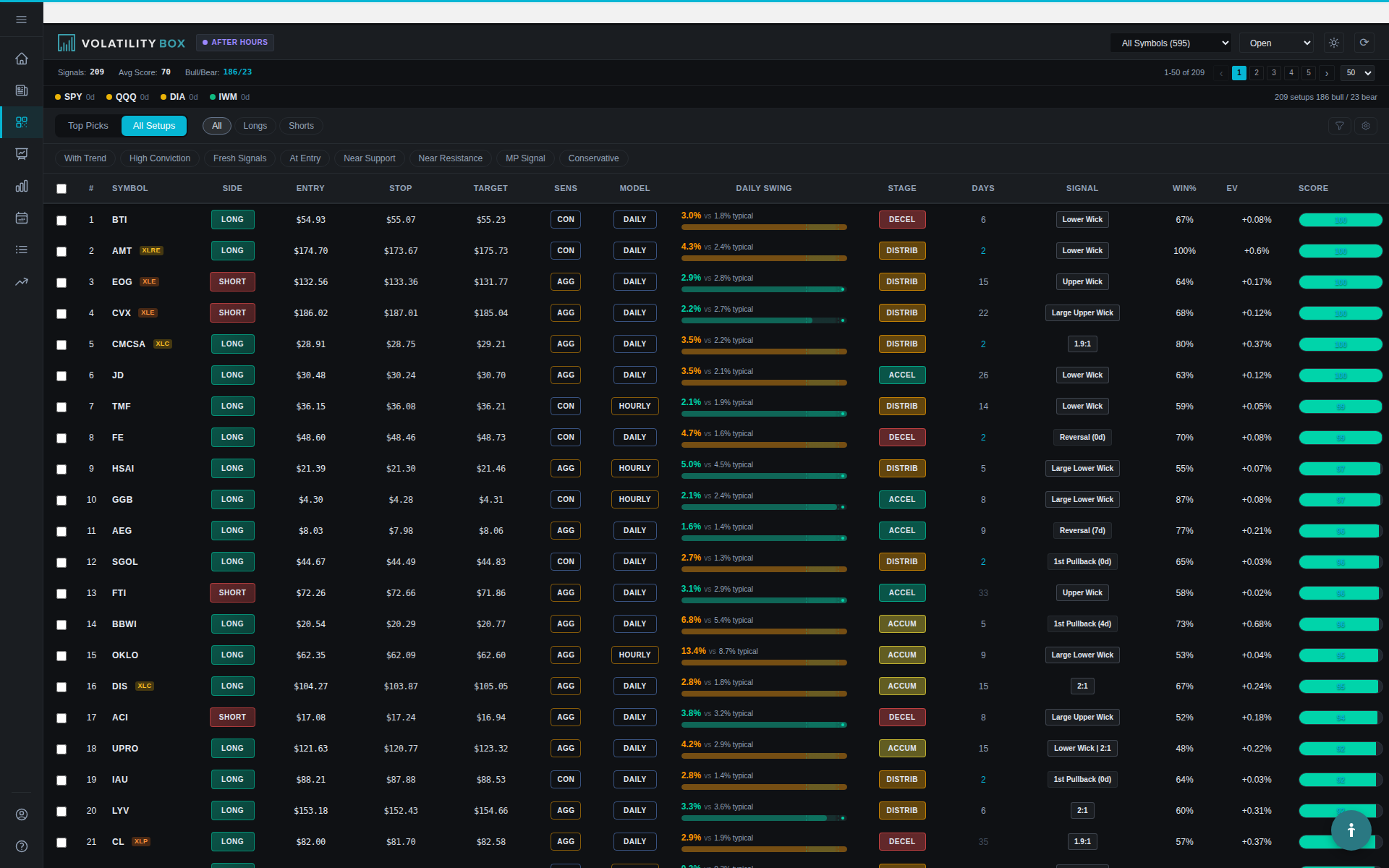
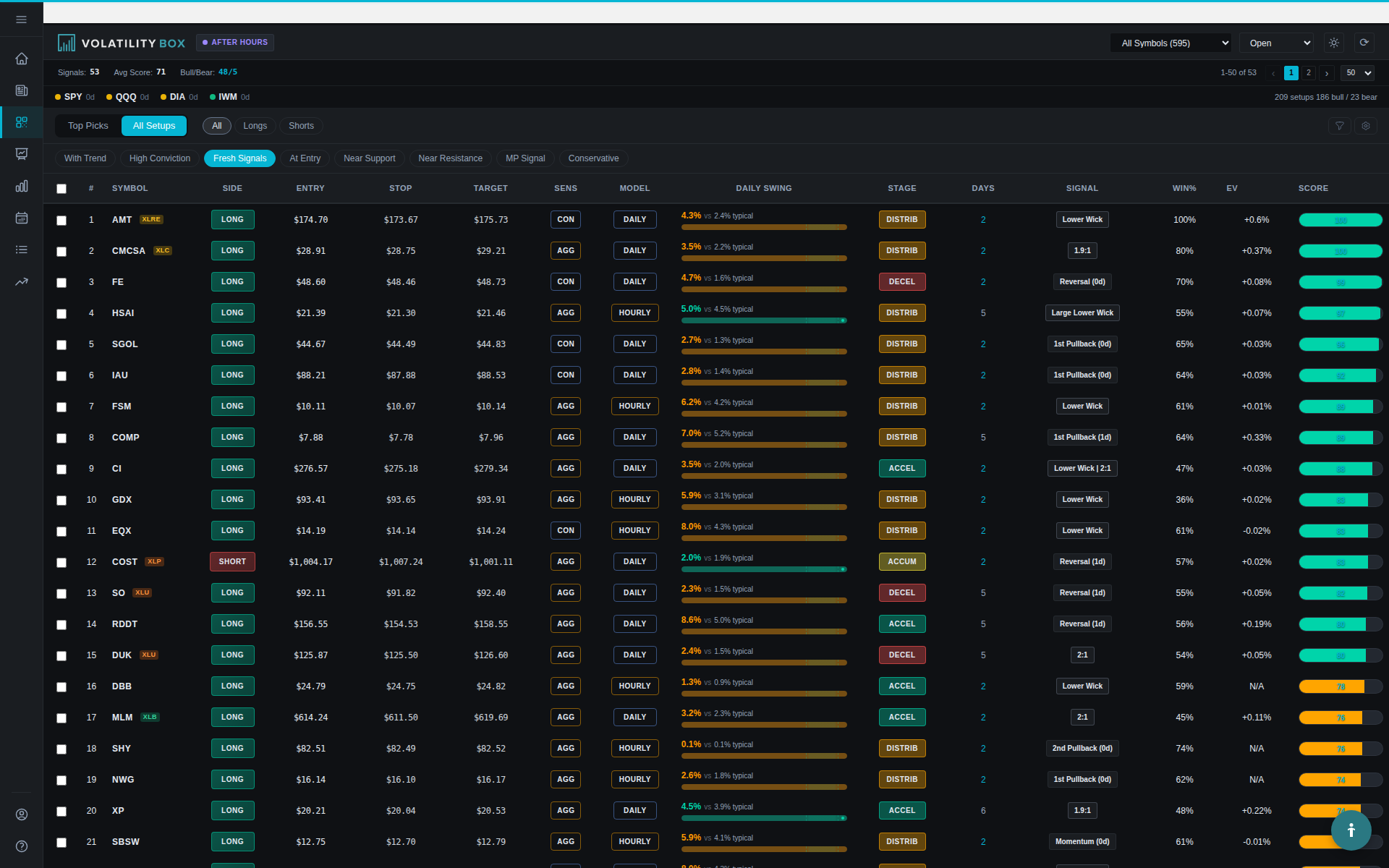
Optimal Scanner filtering for trend following combines Market Pulse factors systematically. Filter for Green or Yellow Market Pulse Color to capture trending markets while excluding chop. Filter for FP or TC Signal Types to focus on high-probability entries. Filter for WITH Trend Alignment exclusively unless you’re an experienced reversal trader. Require conviction of 75 or higher as a baseline, or 80+ for higher quality. Set Status to Open to see only active opportunities. This combination typically produces 5-10 high-quality signals per day that offer 60-70% win rates when executed properly, creating a sustainable edge that compounds over time.

Was this article helpful?

Still need help?

Can't find what you're looking for? Our support team is here to help.

Contact Support