Documentation / Getting Started

Futures vs Stock Volatility Box

Last updated: January 1, 2025

The Futures Volatility Box and Stock Volatility Box are purpose-built tools designed to meet the unique needs of futures and equity traders, each optimized for the specific characteristics of their respective markets. Both provide statistically backed levels to help you make informed decisions based on historical volatility patterns and mathematical models rather than subjective analysis. However, their features, coverage, and use cases differ significantly to suit the specific dynamics of their respective markets, including trading hours, liquidity patterns, and volatility characteristics. This guide provides a detailed breakdown to help you understand and select the tool that best aligns with your trading style, preferred markets, and strategic objectives. Understanding these differences ensures you select the right tool for maximum effectiveness in your specific trading approach.

Futures Volatility Box

The Futures Volatility Box is optimized for the fast-paced, globally traded futures markets where positions can change rapidly and volatility can spike during international trading sessions. It delivers precise, hourly recalculated levels that adapt to changing market conditions throughout the 24-hour trading cycle, ensuring traders always have current data. This enables traders to adapt to the dynamic nature of futures trading and manage risk effectively in volatile conditions that can emerge at any time during the global trading day. The tool is specifically calibrated for the leverage and risk characteristics inherent in futures trading. By providing constant updates throughout the global trading session, the Futures Volatility Box ensures that traders have accurate levels regardless of when they’re active in the markets.

Markets Covered

The Futures Volatility Box supports a curated set of major futures contracts that represent the most liquid and actively traded markets, ensuring comprehensive coverage of key instruments that futures traders focus on. Equity Index Futures include /ES for the S&P 500, /NQ for Nasdaq, /YM for Dow Jones, and /RTY for Russell 2000, covering all major US equity indices. Treasury Futures coverage includes /ZB for the 30-Year Bond, providing access to the fixed income markets. Energy Futures encompass /CL for Crude Oil and /NG for Natural Gas, which are among the most actively traded commodities globally. Metals Futures include /GC for Gold, /SI for Silver, and /HG for Copper, covering precious and industrial metals. Additionally, Micro Futures contracts are supported for all the above markets, providing accessibility for smaller accounts and traders who want to manage risk more precisely with smaller contract sizes. This comprehensive coverage ensures that whether you’re trading indices, bonds, energy, or metals, you have access to the volatility models you need. The focus on the most liquid contracts ensures that the statistical models have sufficient data for accurate calculations.

Key Features

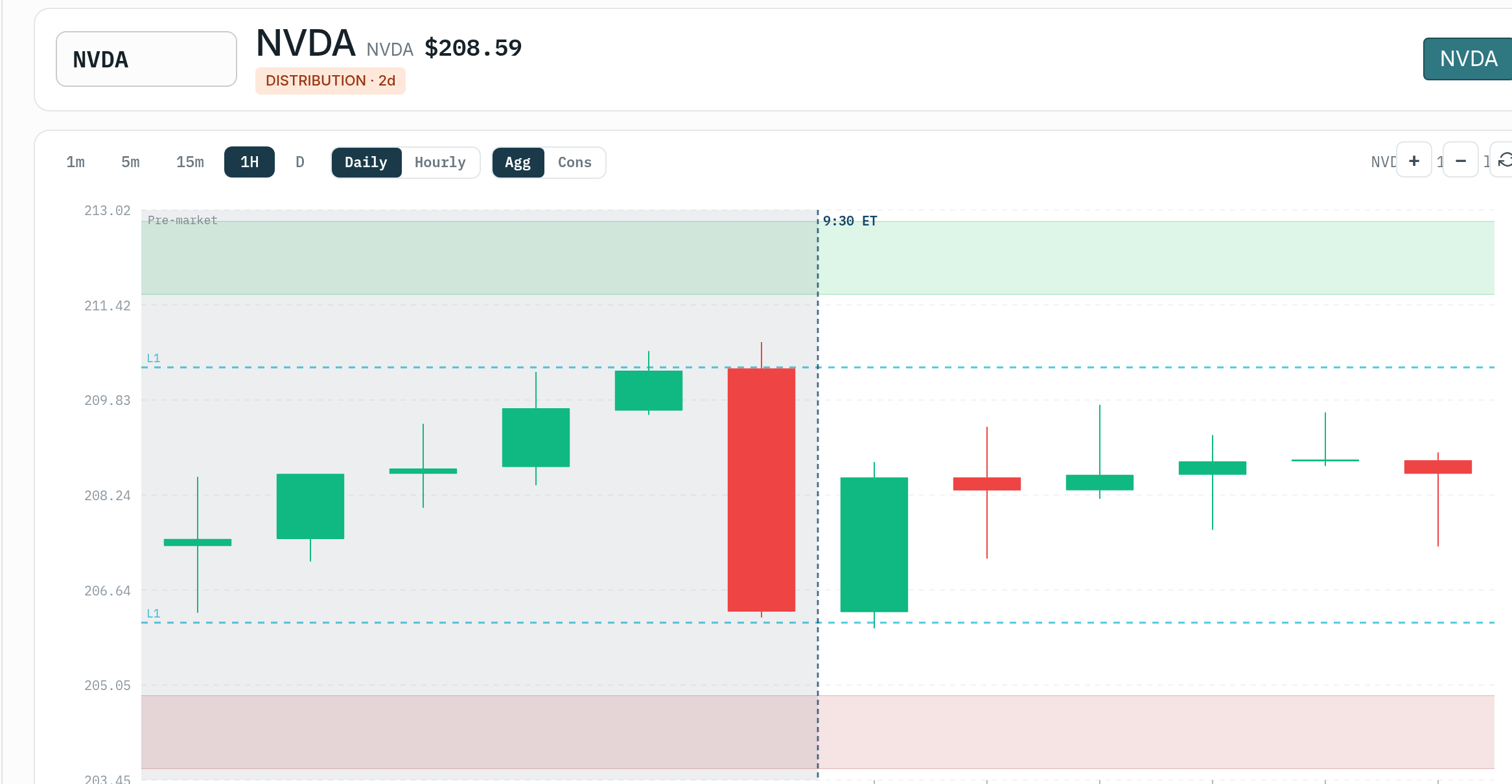
The Futures Volatility Box provides five hourly models that are dynamically recalculated every hour to ensure precision by adapting to changing market conditions throughout the trading session. These levels provide clear entry, stop, and target zones tailored to intraday trading, removing ambiguity from trade planning and execution. The 24/5 coverage aligns with the global nature of futures trading, covering overnight sessions to help you navigate markets during key international trading hours when significant moves can occur. This around-the-clock functionality is critical for futures traders who need to manage positions during Asian or European sessions. Platform integration is seamless with both ThinkOrSwim and TradingView, providing full compatibility with your preferred platform and ensuring you can access the tools regardless of which charting software you use. This flexibility allows you to maintain your existing workflow while adding powerful volatility analysis capabilities. The hourly recalculation ensures that levels remain relevant and accurate as market conditions evolve throughout the day and night.

Use Cases

The Futures Volatility Box is ideal for intraday traders focusing on high-volume futures contracts such as /ES, /NQ, or /CL where precise levels and frequent updates are essential for success. It excels at helping traders manage risk during significant events like economic reports, Federal Reserve announcements, or geopolitical developments that can cause rapid volatility spikes. The tool is particularly valuable for scalping or day trading in highly liquid markets with precise and frequent setups that require up-to-the-minute volatility calculations. Traders who need to monitor positions overnight or during international sessions benefit significantly from the 24/5 coverage that accounts for all trading hours. The constant updates ensure that whether you’re trading during New York hours, London hours, or Asian hours, your volatility levels are current and relevant to actual market conditions.

Stock Volatility Box

The Stock Volatility Box is tailored to equity and ETF traders who need both intraday and swing trading capabilities across a broad range of instruments. It provides hourly and daily models alongside advanced scanning tools to identify opportunities across a vast array of stocks and ETFs, making it easier to find high-probability setups. The platform is designed to cater to both intraday traders who need frequent updates and swing traders seeking broader market insights and longer-term position opportunities. The extensive coverage and scanning capabilities make it ideal for traders who want to identify opportunities across multiple sectors and market conditions. Unlike the Futures box which focuses on a limited set of highly liquid contracts, the Stock box provides breadth of coverage across the entire equity market.

Markets Covered

With coverage of over 11,000 stocks and ETFs, the Stock Volatility Box enables traders to find setups across multiple sectors, market capitalizations, and trading styles. Major Indices coverage includes SPY, QQQ, DIA, IWM, VGT, VOO, and other widely traded index ETFs that represent broad market exposure. Sector ETFs provide coverage across all major sectors with examples including XLF for Financials, XLK for Technology, XLV for Healthcare, and many others representing every sector of the economy. Individual Stocks include most major names like AAPL, MSFT, TSLA, AMZN, and thousands of other actively traded equities across all market capitalizations. The platform also covers both broad and niche ETFs across sectors, markets, themes, and strategies, providing access to virtually any equity instrument you might want to trade. This comprehensive coverage ensures you can apply the same volatility-based approach across your entire portfolio regardless of what you trade. The breadth of coverage transforms the Stock Volatility Box from a simple indicator into a complete market scanning and opportunity identification system.

Key Features

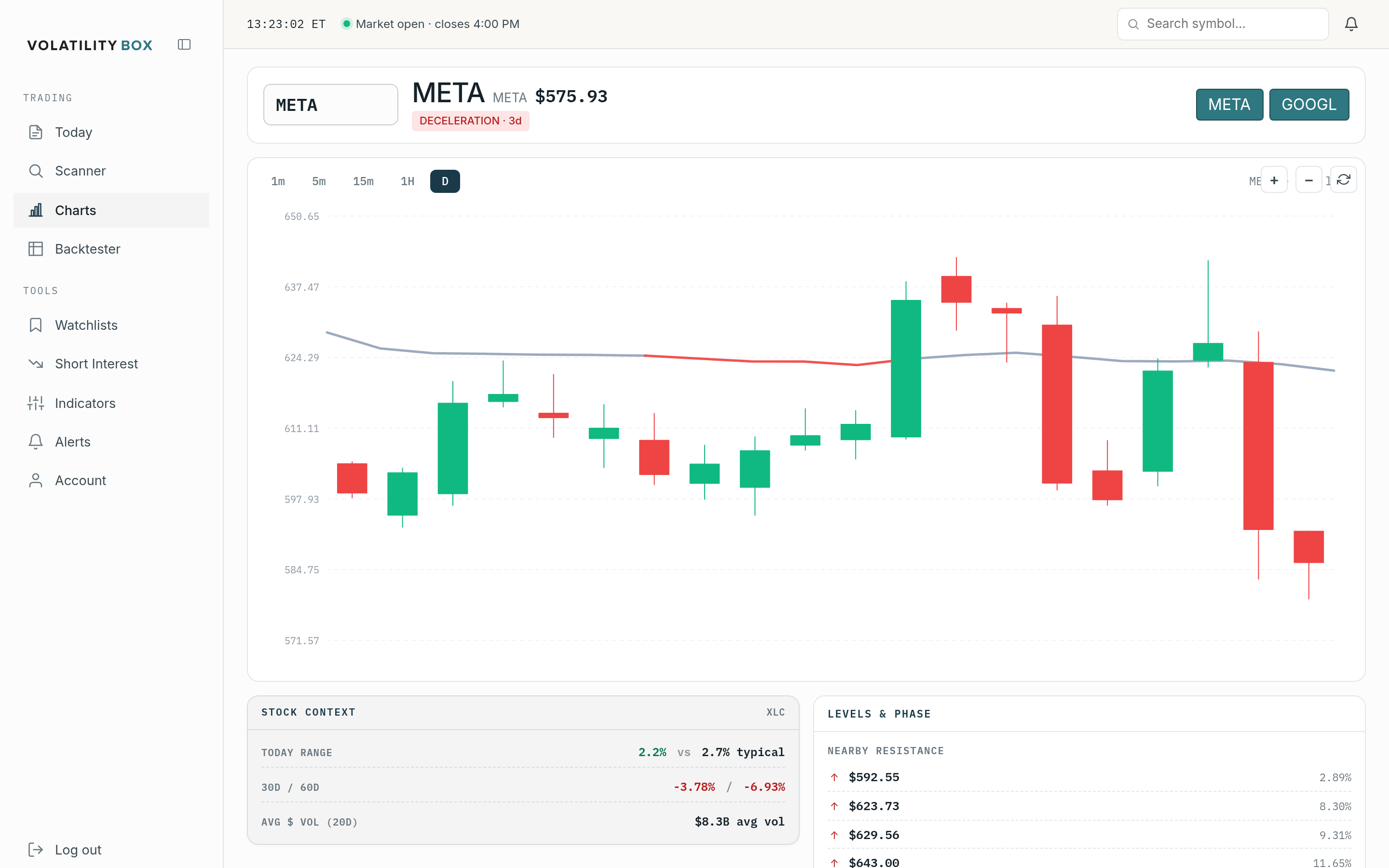
The Stock Volatility Box includes four distinct models consisting of two hourly models for intraday trading and two daily models for larger moves or swing trading setups, providing flexibility across different trading timeframes. The Live Scanner is a powerful tool that tracks real-time breaches across thousands of instruments, highlighting actionable setups immediately as they develop without requiring manual monitoring. The Dashboard aggregates volatility data and shows trends across multiple symbols and sectors to identify market leadership, helping you understand which areas of the market are showing the strongest setups. The Short Interest Scanner is a unique feature that filters for stocks with high short interest and technical setups, such as squeezes, offering unique trade ideas that combine fundamental and technical factors. The platform focuses on regular market hours, designed specifically for U.S. equity trading hours and providing precision during peak trading activity when liquidity is highest. These features work together to create a comprehensive trading platform rather than just an indicator package. The combination of indicators, scanners, and analytical tools provides everything needed for complete market analysis and opportunity identification.

Use Cases

The Stock Volatility Box excels in day trading and swing trading scenarios across both individual stocks and ETFs, accommodating multiple trading styles and timeframes. The platform is ideal for scanning thousands of instruments efficiently to identify volatility-driven opportunities that would be impossible to find through manual chart review. Traders can analyze sector-wide trends to pinpoint leadership or weakness across markets, helping identify where capital is flowing and which sectors are setting up for significant moves. The combination of intraday and daily models makes it suitable for traders who operate across multiple timeframes or who want to scale from day trades to swing positions. The Short Interest Scanner provides unique opportunities for traders interested in squeeze setups and high-short-interest plays that can produce explosive moves. By automating the scanning process, the Stock Volatility Box allows traders to focus on execution and trade management rather than spending hours searching for opportunities manually.

Feature Comparison

Markets covered differ significantly, with the Futures Volatility Box supporting 10 futures contracts plus their micro equivalents, while the Stock Volatility Box covers over 11,000 stocks and ETFs across all sectors and market capitalizations. The model structures are tailored to each market, with Futures providing 5 hourly models for constant intraday updates, while Stocks offer 2 hourly plus 2 daily models to accommodate both day and swing trading. Technology and tools vary considerably, as Futures integrates with ThinkOrSwim and TradingView for charting, while Stocks provides a Live Scanner, Dashboard, and Short Interest Scanner as complete platform features beyond just indicators. Trading hours coverage reflects market characteristics, with Futures offering 24/5 global coverage to match the around-the-clock nature of futures markets, while Stocks focuses on regular U.S. market hours when equities have optimal liquidity. The tools are best suited for different purposes, with Futures optimized for high-frequency futures trading in a limited set of highly liquid contracts, while Stocks excels at both day trading and swing trading across a vast universe of equities and ETFs. Understanding these distinctions helps traders select the appropriate tool for their specific needs and market focus. The key is matching the tool’s strengths to your trading style, preferred markets, and strategic objectives for optimal results.

Selecting the Right Tool

Choosing the right Volatility Box depends on your trading style, preferred markets, available trading time, and strategic objectives. The Futures Volatility Box is ideal for futures traders focusing on contracts like /ES, /NQ, or /CL where the hourly recalculated levels and 24/5 coverage make it a powerful tool for active intraday trading in globally traded markets. Futures traders benefit from the constant updates and around-the-clock coverage that matches the nature of futures markets, particularly those who trade overnight sessions or international market hours. The Stock Volatility Box is best suited for equity and ETF traders who need a blend of intraday and swing trading levels, along with advanced scanning tools for identifying market-wide opportunities efficiently across thousands of potential trades. Stock traders gain significant advantage from the scanning capabilities that highlight setups across the entire market, saving hours of manual chart review and ensuring no opportunities are missed. Both tools are designed to provide a consistent, reliable framework for navigating volatility using statistically validated levels rather than subjective analysis. By understanding their distinct capabilities and how they align with different trading approaches, you can select the tool that maximizes your effectiveness and aligns your trading tools with your strategies for maximum results. Consider your primary markets, trading timeframe, and whether you need broad market scanning or focused coverage when making your selection. The right choice enhances your trading effectiveness while the wrong choice can lead to frustration and suboptimal results, making this decision an important one for your trading success.

Was this article helpful?

Still need help?

Can't find what you're looking for? Our support team is here to help.

Contact Support