Documentation / Getting Started

Understanding Conviction Scores

Last updated: January 1, 2025

What Is the Conviction Score?

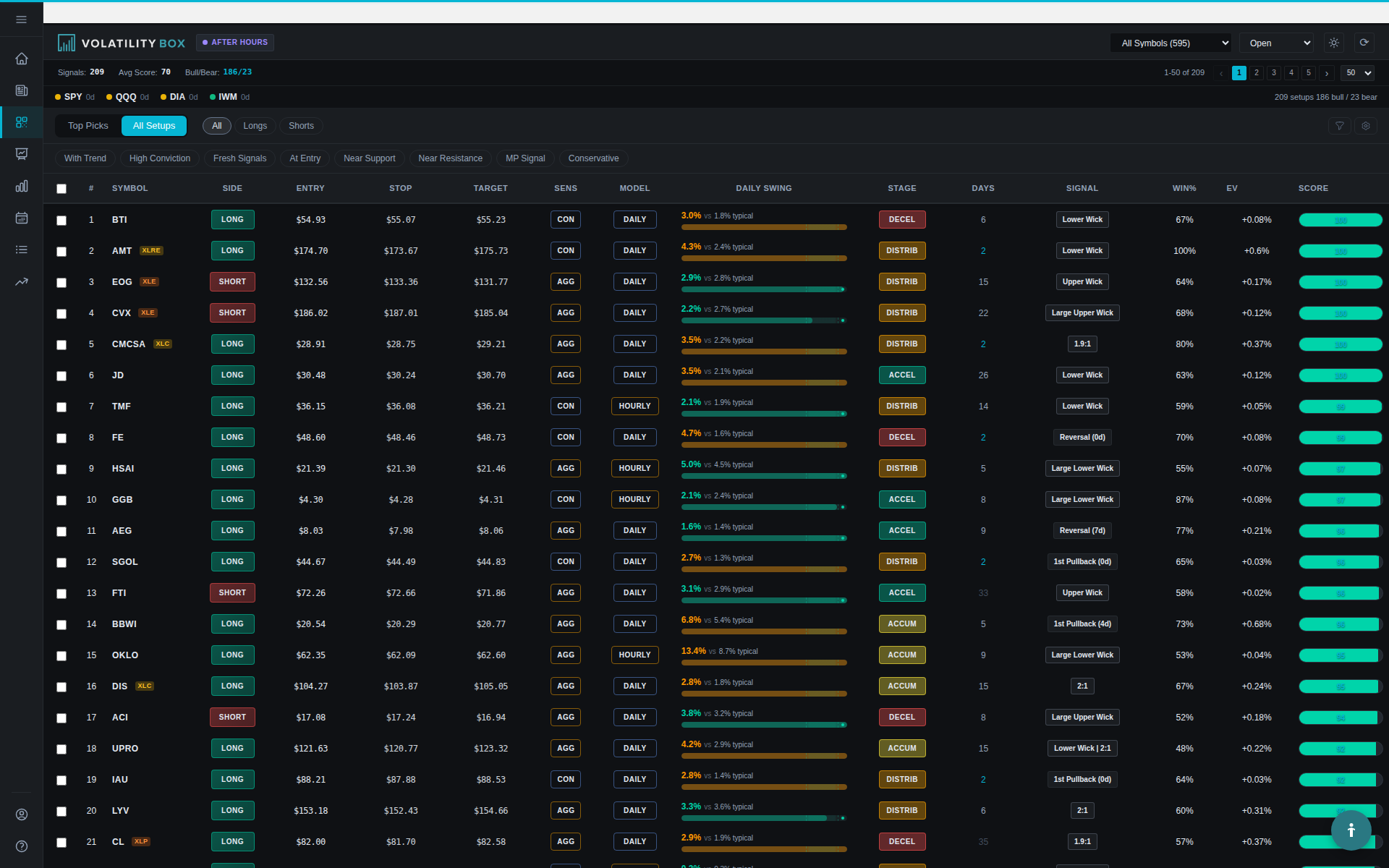
The VB Conviction Score is a 0-100 ranking system that evaluates the quality of each trading signal. Instead of treating all VB breaches equally, the platform analyzes five key factors and assigns points to each, giving you a comprehensive quality assessment. This multi-dimensional scoring prevents you from taking marginal signals that meet only one criterion while failing others.

Think of conviction score as a report card for the signal. A score of 85 means the signal has strong grades across multiple categories – VB performance, momentum, trend alignment, and more. A score of 62 means it’s passing, but has weaknesses in some areas that increase risk or reduce probability of success.

Understanding how the score is calculated helps you identify which signals deserve your capital and attention. You’ll also learn to recognize which factors matter most for your trading style, allowing you to customize your filtering strategy. This knowledge transforms you from blindly following signals to making informed, strategic trade selection decisions.

The Five Components of Conviction Score

Every signal is evaluated across these five factors, each contributing a different maximum point value. The weighting reflects the relative importance of each factor in determining trade success:

  1. VB Performance (0-30 points): Historical win rate, expectancy, and sample size on this symbol
  2. Momentum (0-25 points): Price velocity, trend angle, and volume characteristics
  3. Market Pulse (0-20 points): Trend alignment, signal freshness, and signal type quality
  4. Support/Resistance (0-15 points): Proximity to Darvas box levels and bounce confirmation
  5. Risk/Reward (0-10 points): Entry-to-target ratio and ATR-normalized risk assessment

Let’s break down each component with real examples to show exactly how the scoring works in practice. This illustrates the concept in a practical, real-world context.

Component 1: VB Performance (0-30 points)

This component answers: “How well have VB signals performed on this symbol historically?” Past performance doesn’t guarantee future results, but statistical patterns over 450 days provide meaningful predictive value.

The platform runs 450-day backtests on every symbol and model combination, tracking win rates, expectancy, and total trade count. Signals on symbols with proven performance earn more points because they have demonstrated consistent behavior patterns. A symbol with 60% win rate and +$0.50 expectancy over 100 trades is statistically more reliable than one with only 20 trades and unknown consistency.

Scoring Breakdown

  • Win Rate (0-15 points)
    • 65%+ win rate: 15 points
    • 60-64% win rate: 12 points
    • 55-59% win rate: 9 points
    • 50-54% win rate: 6 points
    • 45-49% win rate: 3 points
    • <45% win rate: 0 points
  • Expectancy (0-10 points)
    • +$0.50+ per trade: 10 points
    • +$0.30-$0.49: 7 points
    • +$0.10-$0.29: 4 points
    • +$0.01-$0.09: 2 points
    • Negative expectancy: 0 points
  • Sample Size (0-5 points)
    • 100+ trades in backtest: 5 points
    • 50-99 trades: 3 points
    • 30-49 trades: 1 point
    • <30 trades: 0 points (not statistically significant)

Real Example

TSLA Hourly Aggressive LONG signal shows: This visualization makes it easy to understand the data at a glance. This information is valuable for understanding how to use the platform more effectively.

  • Win Rate: 62% → 12 points
  • Expectancy: +$0.38 per trade → 7 points
  • Sample Size: 87 trades over 450 days → 3 points
  • Total VB Performance: 22/30 points

This is solid. The signal has proven profitability with a statistically significant sample size. While not perfect (30/30), it scores well enough to indicate this setup has historical edge. The 62% win rate means nearly 2 out of 3 trades hit target, and the positive expectancy means the average trade makes money even accounting for losses.

Component 2: Momentum (0-25 points)

This component measures the strength and quality of the current price move that triggered the signal. Strong momentum at the entry point increases the likelihood that price will continue toward the target rather than reversing back through the stop.

Scoring Breakdown

  • Price Velocity (0-10 points)
    • Measures rate of change over last 5 bars
    • Strong acceleration (2x average): 10 points
    • Moderate acceleration (1.5x): 6 points
    • Normal pace (1x): 3 points
    • Weak/choppy: 0 points
  • Trend Angle (0-10 points)
    • Steep uptrend (45°+ angle): 10 points
    • Moderate uptrend (30-44°): 7 points
    • Gradual uptrend (15-29°): 4 points
    • Sideways or choppy: 0 points
  • Volume Confirmation (0-5 points)
    • Volume 2x+ average: 5 points
    • Volume 1.5-2x average: 3 points
    • Volume near average: 1 point
    • Below average volume: 0 points

Real Example

AAPL LONG signal at 10:15 AM shows: This visualization makes it easy to understand the data at a glance. This information is valuable for understanding how to use the platform more effectively.

  • Price went from $178.20 to $179.50 in 15 minutes (strong velocity) → 10 points
  • Trend angle is 38° based on last 20 bars → 7 points
  • Volume is 1.8x the 20-day average → 3 points
  • Total Momentum: 20/25 points

This signal has strong momentum characteristics – fast move, good angle, volume supporting the direction. The combination of all three factors (velocity, angle, volume) gives high confidence that this isn’t a false breakout but rather a genuine momentum surge with follow-through potential. Signals with weak momentum scores often result in whipsaws or premature reversals.

Component 3: Market Pulse (0-20 points)

Market Pulse assesses the broader trend context and signal timing. Trading with the trend significantly improves win rates, while counter-trend signals require exceptional timing and risk management to succeed.

Scoring Breakdown

  • Trend Alignment (0-10 points)
    • WITH trend + strong trend (Green): 10 points
    • WITH trend + moderate trend (Yellow): 7 points
    • WITH trend + weak trend (Orange): 4 points
    • AGAINST trend: 0 points
  • Signal Type (0-7 points)
    • FP (First Pullback): 7 points – highest probability continuation
    • TC (Trend Continuation): 6 points – established momentum
    • SP (Support Play): 5 points – bounce from key level
    • ME (Mean Extension): 4 points – overextension potential reversal
    • TR (Trend Reversal): 3 points – counter-trend setup
  • Signal Freshness (0-3 points)
    • <30 minutes old: 3 points
    • 30-60 minutes old: 2 points
    • 1-2 hours old: 1 point
    • 2+ hours old: 0 points

Real Example

NVDA LONG signal shows: This visualization makes it easy to understand the data at a glance. This information is valuable for understanding how to use the platform more effectively.

  • WITH trend alignment on Green (strong uptrend) → 10 points
  • Signal type is FP (First Pullback) → 7 points
  • Signal triggered 18 minutes ago → 3 points
  • Total Market Pulse: 20/20 points

Perfect score. This is a fresh First Pullback signal in a strong uptrend – ideal setup. First Pullbacks are among the highest-probability patterns because they catch the resumption of trend after a minor retracement, combining momentum with value entry. The freshness (under 30 minutes old) means you’re getting in early while the setup is still actionable.

Component 4: Support/Resistance (0-15 points)

This component evaluates proximity to key Darvas box levels and price structure. Darvas boxes identify consolidation zones that often act as support and resistance, providing technical confirmation when VB signals align with these levels.

Scoring Breakdown

  • Darvas Level Proximity (0-10 points)
    • Entry within 0.5% of Darvas support/resistance: 10 points
    • Entry within 1% of Darvas level: 6 points
    • Entry within 2% of Darvas level: 3 points
    • No nearby Darvas level: 0 points
  • Bounce Confirmation (0-5 points)
    • Clean bounce off level with rejection wick: 5 points
    • Bounce with some consolidation: 3 points
    • No clear bounce pattern: 0 points

Real Example

SPY LONG signal shows: This visualization makes it easy to understand the data at a glance. This information is valuable for understanding how to use the platform more effectively.

  • Entry at $451.20, Darvas support at $450.80 (0.4% away) → 10 points
  • Clean rejection wick formed at the level before breakout → 5 points
  • Total Support/Resistance: 15/15 points

The signal has confluence with a key support level, adding structural confirmation. When a VB signal triggers near a Darvas level with a clean bounce, you have both statistical and technical validation. This dual confirmation significantly increases the probability that the level will hold and the signal will work.

Component 5: Risk/Reward (0-10 points)

This evaluates the quality of the entry-to-target setup relative to the stop distance. Better risk-reward ratios mean you can be profitable with lower win rates, while poor ratios require very high win rates to overcome unfavorable math.

Scoring Breakdown

  • Reward-to-Risk Ratio (0-7 points)
    • 2:1 or better (target 2x farther than stop): 7 points
    • 1.5:1 to 1.99:1: 5 points
    • 1:1 to 1.49:1: 3 points
    • <1:1 (risk more than reward): 0 points
  • ATR-Normalized Risk (0-3 points)
    • Stop distance <0.5 ATR: 3 points (tight stop relative to volatility)
    • Stop distance 0.5-1.0 ATR: 2 points
    • Stop distance >1.0 ATR: 0 points (wide stop, higher risk)

Real Example

MSFT LONG signal shows: This visualization makes it easy to understand the data at a glance. This information is valuable for understanding how to use the platform more effectively.

  • Entry: $378.50, Stop: $376.80, Target: $381.20
  • Risk: $1.70, Reward: $2.70 → Ratio is 1.59:1 → 5 points
  • ATR is $3.20, stop distance is $1.70 (0.53 ATR) → 2 points
  • Total Risk/Reward: 7/10 points

Decent setup with slightly better reward than risk, and manageable stop distance. This is an important aspect of using the platform effectively.

Putting It All Together: Full Signal Example

Let’s combine all five components for a complete conviction score breakdown: This is an important aspect of using the platform effectively. This information is valuable for understanding how to use the platform more effectively.

AAPL LONG – Hourly Aggressive – 10:15 AM This is an important aspect of using the platform effectively. This information is valuable for understanding how to use the platform more effectively.

  • VB Performance: 22/30 (62% win rate, +$0.38 expectancy, 87 trades)
  • Momentum: 20/25 (strong velocity, good angle, 1.8x volume)
  • Market Pulse: 17/20 (WITH trend on Green, FP signal, 45 min old)
  • Support/Resistance: 8/15 (1.2% from Darvas, minor bounce)
  • Risk/Reward: 7/10 (1.6:1 ratio, 0.6 ATR stop)

Total Conviction Score: 74/100 This is an important aspect of using the platform effectively. This information is valuable for understanding how to use the platform more effectively.

This is a good signal – not excellent, but solid across most factors. The main weakness is support/resistance (only 8/15 points), meaning there’s no strong structural level nearby. But the momentum and Market Pulse are strong, and the VB performance is proven.

A trader looking for 75+ conviction signals would likely take this trade. This is an important aspect of using the platform effectively.

Score Interpretation Guide

Here’s how to interpret conviction scores in practice: This is an important aspect of using the platform effectively. This information is valuable for understanding how to use the platform more effectively.

90-100: Exceptional Quality

Everything is aligned. Strong VB performance, powerful momentum, perfect trend alignment, structural confluence, and favorable risk/reward. These are rare – you might see 1-3 per day. These deserve larger position sizes (within your risk limits) and higher confidence.

80-89: Very Good Quality

Strong across most factors with only minor weaknesses. These are your bread-and-butter setups. Expect 5-10 signals per day in this range. Trade these with full confidence and standard position sizing.

70-79: Good Quality

Solid signals with 1-2 weak areas. Maybe the VB performance is average, or the Market Pulse is AGAINST trend, or the R/R ratio is only 1:1. Still tradeable, but be more selective. Focus on the ones where the weaknesses don’t bother you. You’ll see 10-15 signals per day here.

60-69: Minimum Tradeable

These signals pass minimum thresholds but have multiple weak spots. Trade these only if you have specific expertise on the symbol or the setup type. Reduce position size by 50%. These make up 20-30% of all signals.

Below 60: Skip

Too many weaknesses. Poor VB performance, weak momentum, bad trend alignment, or terrible risk/reward. These occasionally work, but the odds are against you. Save your capital for better setups.

How to Use Conviction Score in Your Workflow

Scanner Filtering Strategy

Set your minimum conviction based on your trading style: This is an important aspect of using the platform effectively. This information is valuable for understanding how to use the platform more effectively.

  • Conservative trader: 80+ only (fewer signals, higher quality)
  • Moderate trader: 75+ (balanced approach, 8-12 signals per day)
  • Aggressive trader: 70+ (more opportunities, accept some weaker setups)
  • Volume trader: 65+ (high trade frequency, small positions)

Position Sizing Based on Conviction

Some traders scale position size with conviction: This is an important aspect of using the platform effectively. This information is valuable for understanding how to use the platform more effectively.

  • 90+ conviction: 2% account risk (maximum position)
  • 80-89 conviction: 1.5% account risk (standard position)
  • 70-79 conviction: 1% account risk (reduced position)
  • 60-69 conviction: 0.5% account risk (minimum position)

This approach automatically increases exposure on the highest-quality setups while keeping you protected on marginal signals. This is an important aspect of using the platform effectively.

Real-World Score Comparisons

Let’s compare two signals side-by-side to see how conviction score helps you choose: This is an important aspect of using the platform effectively. Comparing these options side by side reveals which approach best suits your trading style and goals.

Signal A: TSLA SHORT – Conviction 68 This is an important aspect of using the platform effectively. This information is valuable for understanding how to use the platform more effectively.

  • VB Performance: 18/30 (52% win rate, weak expectancy)
  • Momentum: 15/25 (moderate velocity, okay volume)
  • Market Pulse: 12/20 (WITH trend but Orange color, TR signal)
  • Support/Resistance: 10/15 (near Darvas resistance)
  • Risk/Reward: 13/10 (poor 0.8:1 ratio)

Signal B: AAPL LONG – Conviction 86 This is an important aspect of using the platform effectively. This information is valuable for understanding how to use the platform more effectively.

  • VB Performance: 26/30 (64% win rate, strong expectancy)
  • Momentum: 22/25 (strong velocity, high volume)
  • Market Pulse: 20/20 (WITH Green trend, FP signal)
  • Support/Resistance: 11/15 (near Darvas support)
  • Risk/Reward: 7/10 (1.5:1 ratio)

Signal B is clearly superior. Better VB performance, stronger momentum, perfect Market Pulse, and better risk/reward. If you only had capital for one trade, Signal B is the obvious choice.

Common Questions About Conviction Score

Q: Can I see the score breakdown for each signal? This is an important aspect of using the platform effectively.

The detailed breakdown isn’t shown in the Scanner table (it would be too cluttered), but you can see the underlying data: win rate, expectancy, Market Pulse type, R/R ratio, etc. With practice, you’ll learn to quickly assess which factors are strong or weak.

Q: Should I ever trade signals below 70 conviction? This is an important aspect of using the platform effectively.

It depends on your edge. If you have deep expertise on a specific symbol and know it tends to run through VB targets, you might trade 65+ signals on that symbol. But for most traders, 70+ is a good minimum threshold to ensure quality over quantity.

Q: Do higher conviction scores guarantee wins? This is an important aspect of using the platform effectively.

No. A 90 conviction signal might stop out, and a 70 conviction signal might hit its target. Conviction score is about probability and quality, not certainty. Over 50-100 trades, higher conviction signals will perform better statistically, but individual trades are always uncertain.

Q: How often are conviction scores updated? This is an important aspect of using the platform effectively.

Scores update in real-time as new data comes in. A signal might start at 78 conviction and rise to 82 if volume surges or Market Pulse improves. Conversely, it might drop to 74 if momentum fades. Check signal freshness – older signals may have outdated scores.

Key Takeaways

  1. Conviction score combines five factors: VB Performance, Momentum, Market Pulse, Support/Resistance, and Risk/Reward
  2. Each factor contributes differently: VB Performance is worth up to 30 points, Momentum 25, Market Pulse 20, Support/Resistance 15, Risk/Reward 10
  3. Scores of 80+ represent high-quality setups with strong multi-factor confirmation
  4. Scores of 70-79 are tradeable but require more selectivity
  5. Scores below 70 should be avoided unless you have specific expertise
  6. Use conviction score as a sorting and filtering tool to prioritize your best opportunities
  7. Consider scaling position size with conviction to maximize exposure on the best setups

Understanding conviction score transforms the Scanner from an overwhelming list of signals into a curated menu of quality setups. Focus on the top-scoring signals, and you’ll naturally improve your win rate and expectancy over time.

Was this article helpful?

Still need help?

Can't find what you're looking for? Our support team is here to help.

Contact Support