Our Dow 30 retest study established that entries at the outer Volatility Box levels won about 61% of 13,505 trades over the past two years. This follow-up asks a simpler question: does it matter what time of day the retest happens?
It does. The edge is strongest in the mid-morning, sags hard over lunch, and comes back for the afternoon session.
The lunch lull that floor traders have complained about forever is measurable in our own trade log.
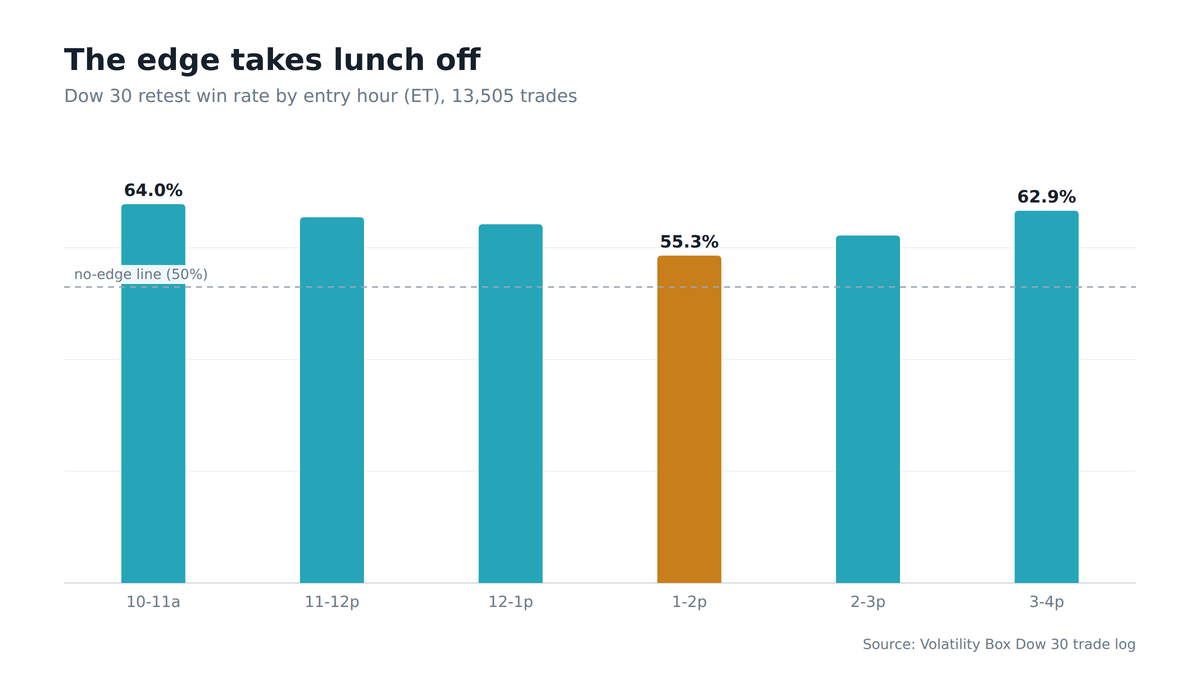
The edge by hour
Every trade from the same study, grouped by the hour of entry, Eastern time. Same symmetric one-R target and stop throughout, so 50% is the no-edge line.
| Entry hour (ET) | Trades | Win rate | Avg R per trade |
|---|---|---|---|
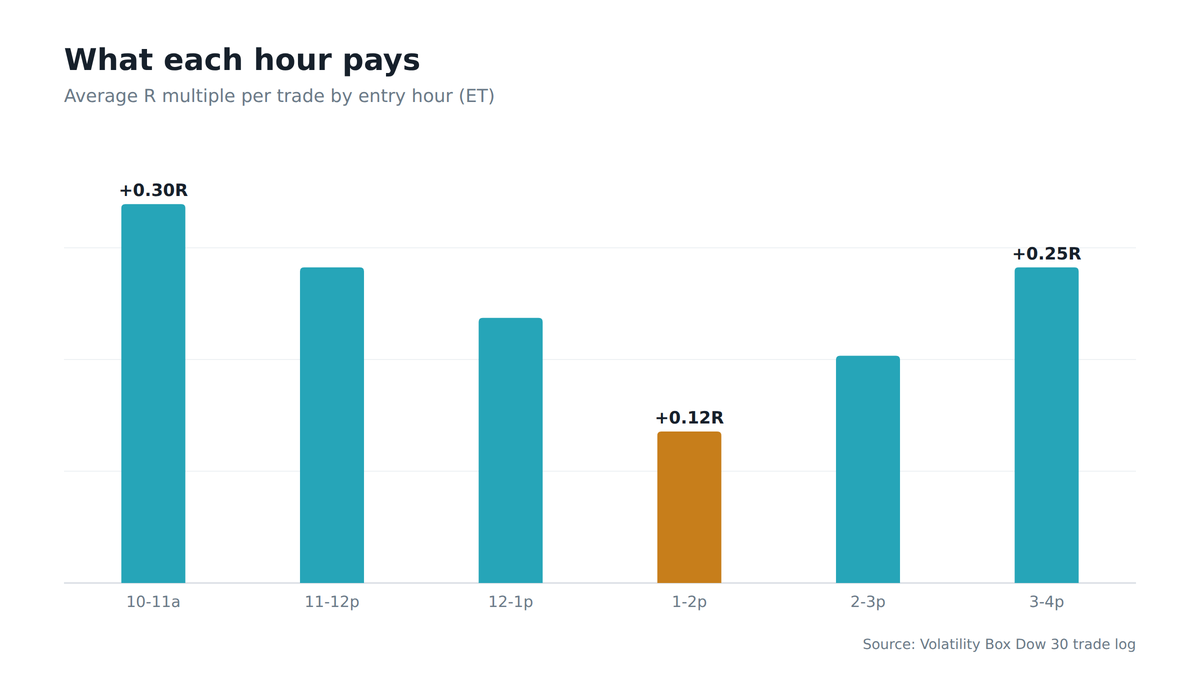
| 10:00 – 11:00 | 1,410 | 64.0% | +0.30 |
| 11:00 – 12:00 | 2,663 | 61.8% | +0.25 |
| 12:00 – 1:00 | 1,334 | 60.6% | +0.21 |
| 1:00 – 2:00 | 1,812 | 55.3% | +0.12 |
| 2:00 – 3:00 | 2,848 | 58.7% | +0.18 |
| 3:00 – 4:00 | 2,340 | 62.9% | +0.25 |
The shape is a smile with a dent in it.
- Mid-morning is the peak: retests after the opening chaos has settled, but while real volume is still trading, won 64% at +0.30R.
- Lunch is the dent: the edge decays steadily into the 1 o’clock hour, the day’s clear low at 55.3% and less than half the morning’s expectancy.
- The afternoon recovers: the climb back is just as steady, and the 3 o’clock hour nearly matches the morning.
Why lunch is the worst hour for a reversion trade
A retest at the edge of the Volatility Box is a bet that enough participation exists to push price back toward its statistical center.
Over lunch, that participation thins out. It is the same midday drop-off we map in our guide to timing the open, midday, and close, and it hits a reversion trade in three ways:
- Desks step back: institutional participation fades until the afternoon session.
- Volume drops: there is less flow available to fuel a snap-back.
- Drift replaces conviction: price can slide beyond a level on very little conviction without generating the reversion the trade depends on.
A breach that happens on thin lunch flow simply means less than the same breach at 10:30, when it took real volume to get there.
The sweet spot is not the open
It is worth noticing what this is not. The first half hour, before 10:00, produces comparatively few retest entries in our log.
The levels are rarely reached that fast, and the trades that do occur there are not the day’s best. Unlike an opening range breakout, this system’s sweet spot is not the open itself.
It is the hour after it, when the opening auction has finished arguing and the day’s real ranges are being tested with the day’s real volume.
Practical reading
None of the six hours is a losing hour, which matters: the levels carried their edge all day, every hour above 55%, and we would not decline a clean setup purely because of the clock.
But the spread between 64% at +0.30R and 55% at +0.12R is too wide to ignore when calibrating aggression.
The data supports leaning into mid-morning and late-afternoon retests, and treating the 1 o’clock hour the way you would treat a marginal setup: acceptable with confluence, unconvincing alone.
The fine print
Same caveats as the parent study:
- Scope: two years of Dow 30 data.
- Modeled fills: results assume fills at the level with symmetric exits.
- Nothing is fixed: hour-of-day patterns can shift as market structure does. We will keep re-measuring as the log grows.
Keep reading
Frequently asked questions
What is the best hour of the day to trade a Volatility Box retest?
The mid-morning 10:00 to 11:00 hour is the best, winning 64.0% across 1,410 trades at +0.30R per trade. This is the day’s peak, after the opening chaos has settled but while real volume is still trading. It is the single strongest hour in the study.
What is the worst hour to trade a mean-reversion retest?
The 1:00 to 2:00 hour is the worst, with a 55.3% win rate across 1,812 trades and just +0.12R per trade. That expectancy is barely a third of the mid-morning rate. It still clears the 50% no-edge line, but it is the day’s clear low.
Why does the retest edge weaken over the lunch hour?
The 1 o’clock hour drops to +0.12R because participation thins out midday. Institutional desks step back until the afternoon, volume falls so there is less flow to fuel a snap-back, and price can drift beyond a level on little conviction rather than reverting.
Does the retest edge recover in the afternoon?
Yes. The 3:00 to 4:00 hour rebounds to 62.9% across 2,340 trades at +0.25R, nearly matching the mid-morning peak. The climb back from the lunch low is steady, so a late-afternoon retest deserves the same respect as a morning one.
Is any hour of the trading day actually unprofitable for this setup?
No. None of the six hours is a losing hour, with every hour above 55% and all clearing the 50% no-edge line. The levels carried their edge all day, so a clean setup would not be declined purely because of the clock.
Should you trade the market open with this system?
No, the open is not the sweet spot. The first half hour before 10:00 produces comparatively few retest entries, and those trades are not the day’s best. The levels are rarely reached that fast; the edge lives in the hour after the open, when real ranges test on real volume.