Delta beat, then faded into the lower Volatility Box: the $DAL long that hit 2.0R in 2 minutes
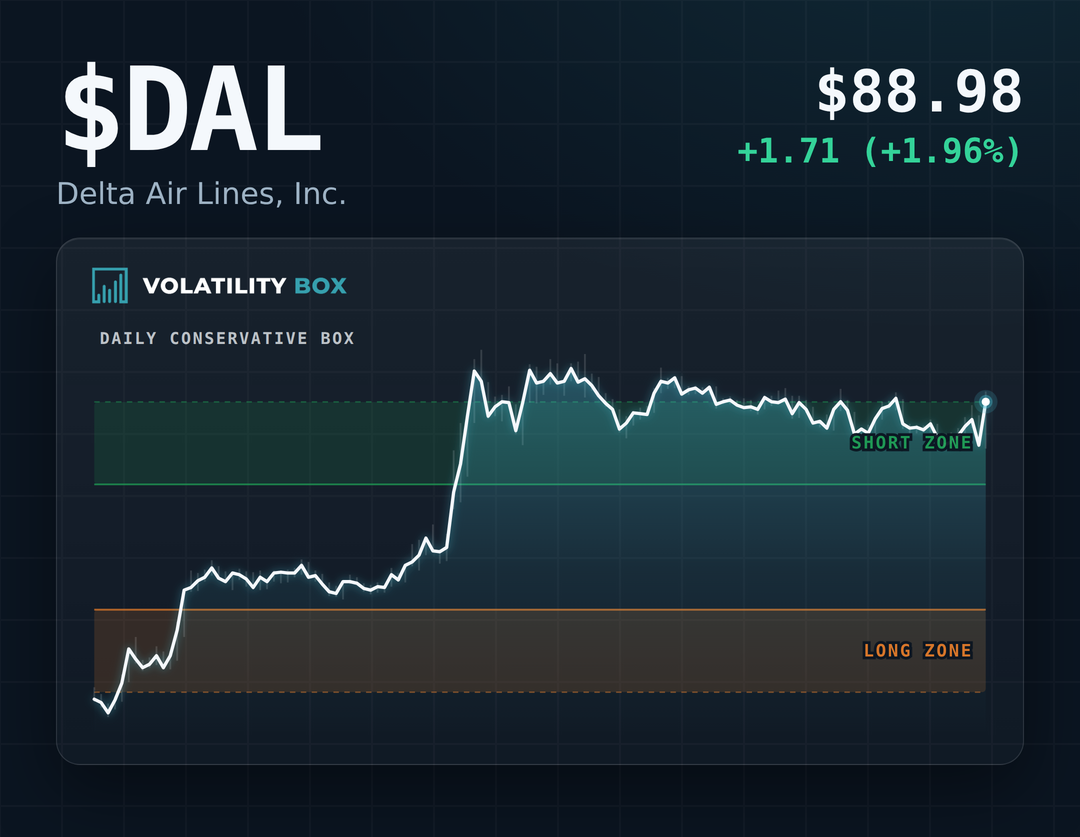
The beat the tape ignored
Delta Air Lines reported second quarter results before the bell on July 10, and on paper it was a beat. Adjusted earnings came in at $1.56 a share against $1.48 expected, revenue was $17.67B, and management reaffirmed full-year guidance.
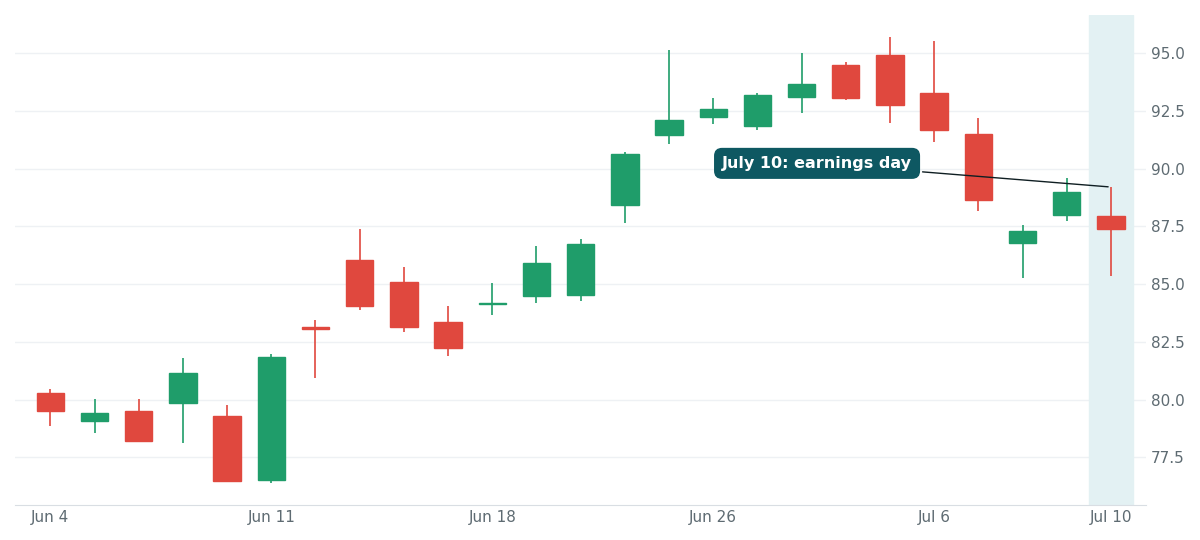
The stock did not celebrate. $DAL slid from near $89 toward the lower edge of its Daily Conservative Volatility Box, with adjusted jet fuel running about 75% higher year over year at $3.93 a gallon.
That pullback is the setup. The Volatility Box does not care whether the news was good. It marks the levels where price has become statistically stretched, and a strong report selling off is exactly how a name reaches the lower edge.
The trade off the lower Volatility Box zone
$DAL tagged the L3 level of the Daily Conservative Volatility Box at $85.57. That is the lower cloud, the long zone, where the model reads the move as overdone to the downside, and the Edge Signal confirmed the entry there.

The target was $86.54, and it hit in 2 minutes for 2.0R, a +1.1% move to target. The stop at $85.08 was set before the entry ever triggered, so the risk on the trade was defined before the trade existed.
That is the whole point of trading from the Volatility Box: the level, the entry, and the exit are drawn first.
Why the Volatility Box marks the extreme
The Volatility Box is counter-trend by design. The upper cloud is the fade zone, the lower cloud is the long zone, and the Edge Signal is the entry trigger on top of those levels. Proof is measured from the Edge Signal entry across the whole system, never from any single name.
One clean trade on Delta is not the edge. The edge is what those Edge Signal entries do across thousands of trades with defined risk on each one.
The honest read
A good earnings report is not a reason to chase, and a sell-off after a beat is not a reason to panic. $DAL reached a downside statistical extreme, the Edge Signal went long, and the target hit fast with the risk fixed in advance.
The news gave the move its reason. The Volatility Box gave it a level.
| Date | Friday, July 10, 2026 (earnings day) |
|---|---|
| Model | Daily Conservative Volatility Box |
| Level | Lower L3 |
| Direction | Long (counter-trend bounce) |
| Entry | $85.57 at 10:33 a.m. ET |
| Stop | $85.08, set before entry |
| Target | $86.54 |
| Time to target | 2 minutes |
| Result | 2.0R, a 1.1% move |
How the zones are drawn and read is covered in Reading the models.
What happened next
The bounce off the lower Volatility Box zone kept going for a while. After the target, $DAL rallied as high as $88.00, almost back to the prior close of $89.00, and closed at $87.36.
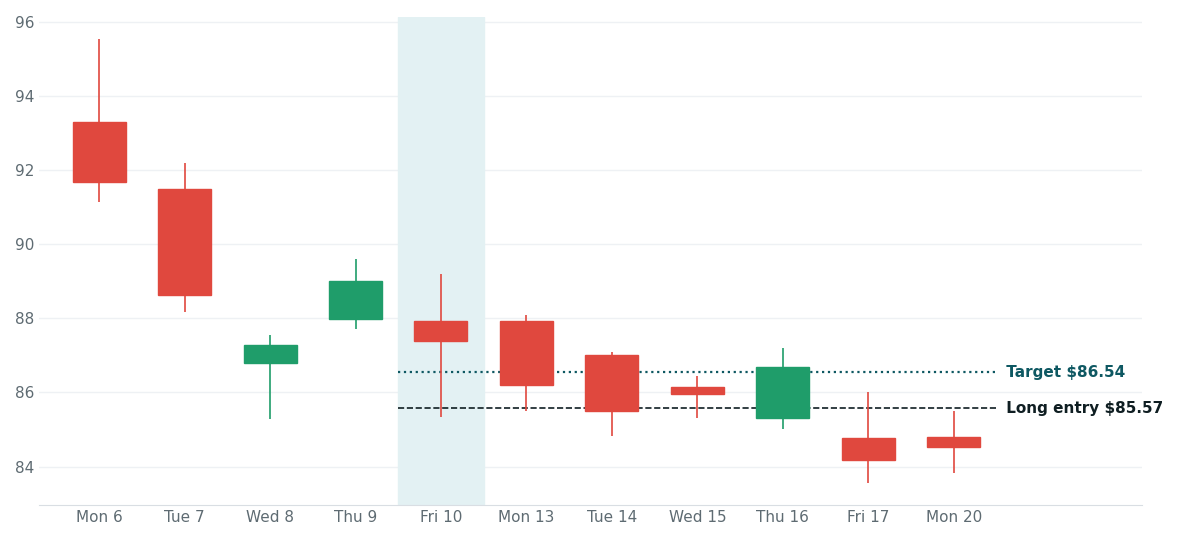
It did not last into the next week. $DAL closed at $86.19 on Monday, $85.51 on Tuesday, and $84.17 by July 17, below the L3 entry. The lower Volatility Box zone marked an intraday extreme on earnings day. It did not mark the low for the month, and it never claimed to.
An intraday level, not a swing call
This is the most common way traders misread the Volatility Box. The daily Volatility Box model measures how far price usually travels in one session.
When price reaches the outer levels, the odds favor a move back toward the middle of the range, today. A stock can still trend lower over the following weeks while the Volatility Box keeps marking good intraday turns along the way.
Market Pulse had $DAL in a Green stage going into the report, with a long signal on July 7. The earnings-day flush pulled price to a downside extreme inside that trend, and the bounce off L3 took two minutes to reach its target.
The trend stages are explained in Market Pulse signals.
Questions traders ask about this setup
Did the Volatility Box call the bottom in Delta?
No. It marked a level where the earnings-day selloff was statistically stretched for that session. The bounce from there hit its target in two minutes. Delta traded lower the following week, which is a separate question the Volatility Box does not try to answer.
Why is the stop so close?
The stop sits just past the level, where the setup would be wrong. At $85.08 it risked 49 cents to make 97 cents. A close stop is what makes a 2R target realistic on an intraday move.
What is an Edge Signal?
It is the entry trigger that fires on top of a Volatility Box level. The Volatility Box tells you where price is stretched; the Edge Signal tells you when the move has started to turn there. Members see both on the same chart.